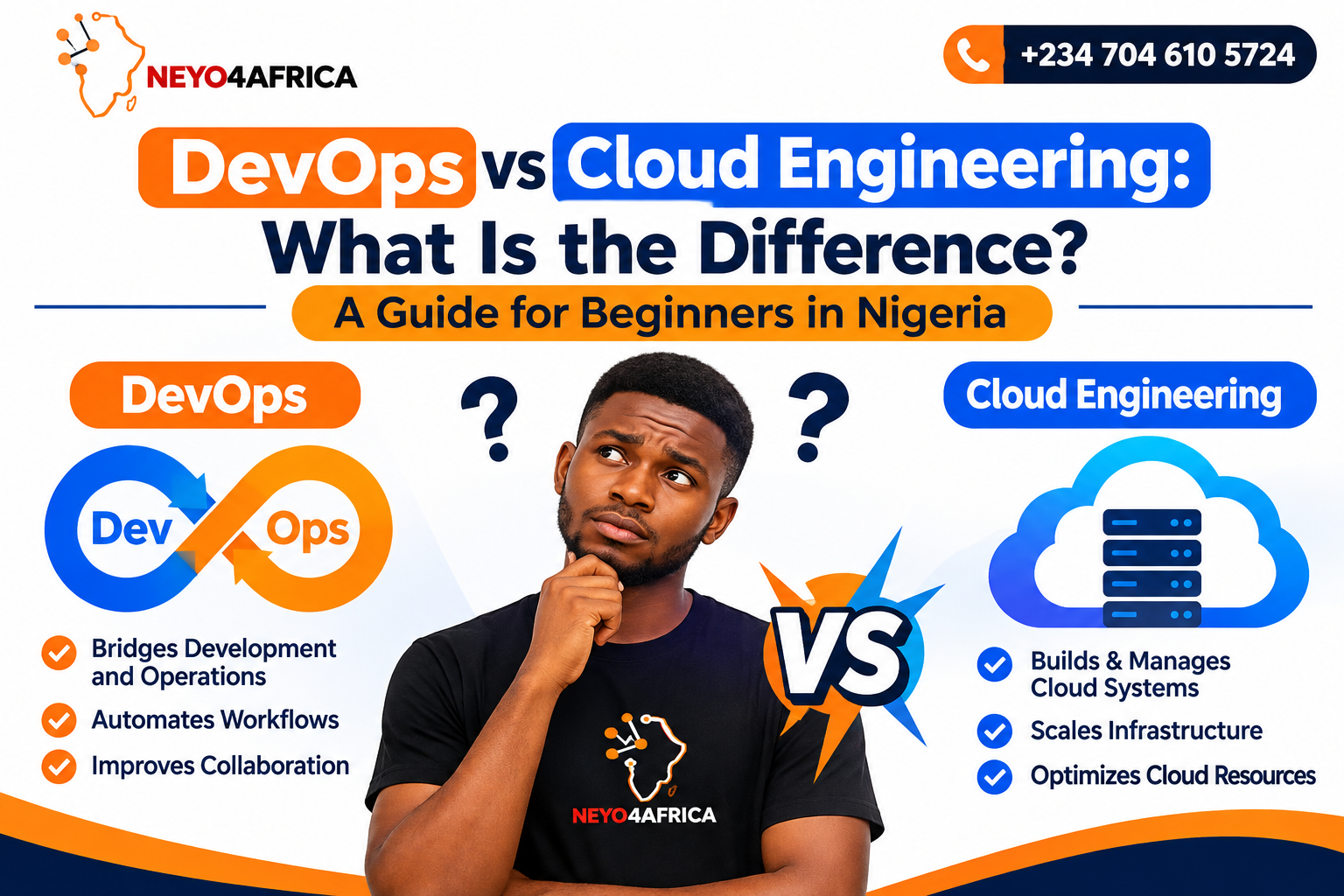
Technology is creating new career opportunities for people who want to work in software development, cloud computing, and IT infrastructure. Two career paths that often attract beginners are DevOps engineering and cloud engineering.
Although these roles share some skills and tools, they are not exactly the same. A cloud engineer generally focuses on designing, building, and managing cloud infrastructure, while a DevOps engineer focuses on improving how software is built, tested, deployed, and maintained through automation and collaboration.
If you are considering a technology career in Nigeria, understanding the differences can help you choose where to begin and which skills to develop.
What Is DevOps Engineering?
DevOps engineering combines software development practices with IT operations to help organisations deliver software efficiently and reliably.
A DevOps engineer works with developers, infrastructure teams, testers, and security professionals to automate repetitive tasks, improve deployment processes, monitor applications, and reduce problems during software releases.
For example, imagine a company develops a mobile banking application. Every time developers update the application, the changes must be tested, packaged, and prepared for release. A DevOps engineer can automate much of this process using continuous integration and continuous delivery (CI/CD) pipelines.
Common DevOps responsibilities include:
- Automating software builds, tests, and deployments.
- Creating and maintaining CI/CD pipelines.
- Using Docker and Kubernetes to manage containerised applications.
- Writing scripts to automate repetitive tasks.
- Monitoring applications and investigating failures.
- Managing infrastructure through code.
- Supporting security checks and reliable software releases.
Popular DevOps tools include Git, GitHub Actions, Jenkins, Docker, Kubernetes, Terraform, and monitoring platforms such as Prometheus and Grafana.
Microsoft Learn describes DevOps as a role involving collaboration, source control, automation, security, continuous integration, delivery, deployment, and monitoring.
What Is Cloud Engineering?
Cloud engineering focuses on designing, deploying, configuring, securing, and maintaining computing resources on cloud platforms.
Instead of depending entirely on physical servers owned by a company, organisations can use cloud services to host applications, store data, manage networks, and scale their infrastructure as their needs change.
A cloud engineer helps ensure that these cloud resources are configured correctly, secure, reliable, and suitable for the organisation's requirements.
For example, an e-commerce business may need cloud servers to host its website, databases to store orders, storage for product images, and networking to connect its services. A cloud engineer may design and manage this environment.
Common cloud engineering responsibilities include:
- Setting up and managing cloud infrastructure.
- Configuring virtual machines, storage, and cloud networks.
- Managing identity and access permissions.
- Supporting backups, disaster recovery, and availability.
- Monitoring cloud resource usage and costs.
- Implementing security controls.
- Automating infrastructure provisioning and maintenance.
Popular cloud platforms include Amazon Web Services (AWS), Microsoft Azure, and Google Cloud.
Cloud engineers may specialise in areas such as cloud architecture, cloud security, networking, infrastructure operations, or cloud data services.
DevOps vs Cloud Engineering: Key Differences
The main difference is the focus of each role. DevOps engineering concentrates on software delivery and operational automation, while cloud engineering concentrates on cloud infrastructure and services. In practice, responsibilities often overlap.
AreaDevOps EngineeringCloud Engineering
Main focus | Automating and improving software delivery | Building and managing cloud infrastructure
Typical work | CI/CD pipelines, deployment, automation, monitoring | Cloud servers, networking, storage, access and security
Programming | Scripting and infrastructure configuration | Scripting and infrastructure automation
Common tools | GitHub Actions, Jenkins, Docker, Kubernetes | AWS, Azure, Google Cloud, cloud networking tools
Infrastructure as Code | Used to automate infrastructure for applications | Used to provision and manage cloud resources
Collaboration | Often works closely with developers and operations teams | Often works with infrastructure, security, networking and application teams
Main objective | Deliver software reliably and efficiently | Provide secure, reliable and suitable cloud infrastructure
Neither role is limited to the tasks in this table. The responsibilities of individual engineers depend on the employer, the size of the team, and the technology being used.
What Skills Do You Need for Each Career?
There is a shared foundation, so you do not need to choose a specialisation before learning the basics.
Essential skills for DevOps engineers
1. Linux: Learn the command line, file permissions, processes, services, and basic troubleshooting.
2. Git and version control: Understand how to track code changes and collaborate with other developers.
3. Scripting: Learn Bash or Python to automate repetitive tasks.
4. CI/CD: Understand how code moves from development through testing and deployment.
5. Containers: Learn Docker fundamentals and progress to Kubernetes when you understand the basics.
6. Monitoring and troubleshooting: Learn how to interpret logs, identify failures, and investigate performance problems.
7. Infrastructure as Code: Learn how tools such as Terraform can define and manage infrastructure.
Essential skills for cloud engineers
1. Cloud fundamentals: Understand the main services offered by AWS, Azure, or Google Cloud.
2. Networking: Learn IP addressing, DNS, ports, firewalls, routing, and secure connections.
3. Linux and operating systems: Understand server administration and basic troubleshooting.
4. Cloud security: Learn identity management, permissions, encryption, and secure configuration.
5. Infrastructure management: Practise creating and managing virtual machines, storage, networks, and other cloud resources.
6. Automation: Learn scripting and infrastructure automation to reduce manual work.
7. Reliability and cost management: Understand backups, availability, recovery, monitoring, and how to manage cloud spending.
If you are starting from zero, concentrate on Linux, networking, Git, and basic scripting before moving into advanced tools.
Which Tools Should Beginners Learn First?
You do not need to master every tool to get started. Learn tools that develop transferable skills and build on them gradually.
Learning stageDevOps directionCloud engineering direction
Foundation | Linux, Git, networking | Linux, networking, cloud fundamentals
Beginner practice | Bash or Python, GitHub Actions | One cloud platform, virtual machines and storage
Intermediate | Docker, CI/CD, Terraform | Cloud networking, identity, monitoring and Terraform
Advanced | Kubernetes, deployment strategies, observability | Cloud architecture, resilience, security and cost optimisation
Choose one cloud provider initially rather than attempting to learn all three simultaneously. Once you understand the core concepts, you can explore other platforms.
DevOps vs Cloud Engineering: Which Is Easier to Learn?
Neither career is automatically easier. The difficulty depends on your existing knowledge and the kind of work you enjoy.
Cloud engineering may feel more approachable if you are interested in servers, networking, infrastructure, and configuring cloud services. However, advanced cloud roles require substantial technical knowledge and practical experience.
DevOps may appeal to you if you enjoy automation, scripting, software development workflows, and solving problems that occur during deployment and operations.
Both paths require troubleshooting, continuous learning, and practical projects. Neither guarantees a job after completing a course or earning a certification.
Which Career Has Better Job Opportunities in Nigeria?
Both DevOps and cloud engineering can be relevant to Nigerian businesses and international organisations that operate digital services.
Potential employers include:
- Fintech and financial services companies.
- Software development firms.
- Telecommunications companies.
- E-commerce businesses.
- Cloud and IT consulting providers.
- Technology startups.
- Large organisations operating online platforms.
Some positions may be remote or hybrid, but availability varies by employer. Entry-level opportunities may also require prior IT experience, demonstrable projects, or knowledge beyond introductory courses.
Rather than choosing based only on job titles, review vacancies you would like to qualify for. Compare their requirements and use those requirements to plan your learning.
DevOps Engineer vs Cloud Engineer: Which Pays More?
There is no universal answer. Salaries vary by employer, experience, technical specialisation, location, and whether the position is local or international.
A senior cloud architect may earn more than a junior DevOps engineer, while an experienced DevOps specialist may earn more than someone in an entry-level cloud role.
When comparing job opportunities, look at the actual responsibilities, required experience, benefits, and compensation offered. Avoid relying on a single salary figure as a reliable representation of either career.
Can You Become Both a DevOps Engineer and a Cloud Engineer?
Yes. The two career paths complement each other, and many professionals develop skills across both areas.
For example, a cloud engineer may learn CI/CD and Docker to automate application deployments. A DevOps engineer may develop deeper cloud architecture and networking skills to manage infrastructure more effectively.
Learning both areas can broaden your technical understanding, but you do not need to master everything at once. Start with a clear foundation and develop skills based on your career goals.
A Practical Learning Roadmap for Beginners in Nigeria
If you are unsure which career to choose, follow this foundation-first approach.
Phase 1: Learn the fundamentals
Start with Linux, networking, Git, and basic command-line operations. Practise using a local development environment or a suitable virtual machine.
Phase 2: Learn basic scripting
Choose Bash or Python and write small scripts to automate simple tasks, such as organising files, checking service status, or processing logs.
Phase 3: Choose a cloud platform
Explore AWS, Microsoft Azure, or Google Cloud. Learn how to create basic resources, configure permissions, monitor usage, and understand costs.
Be careful with paid resources. Check pricing and available free-tier conditions before creating services, and remove resources you no longer need.
Phase 4: Choose a specialisation
If you prefer infrastructure, cloud networking, access management, and cloud architecture, explore cloud engineering.
If you prefer automation, CI/CD pipelines, containers, and reliable software deployment, explore DevOps engineering.
Phase 5: Build practical projects
Try these beginner projects:
- Deploy a simple website to a cloud server.
- Store a project in GitHub and configure an automated build workflow.
- Package a simple application using Docker.
- Create a small cloud environment and document its network and security settings.
- Use Terraform to define a test environment.
- Configure basic monitoring and explain how you would investigate a failure.
Document each project, including the problem, tools, steps, and results. Never publish passwords, access tokens, private keys, or other secrets in a public repository.
Phase 6: Prepare for opportunities
Review relevant job descriptions, identify recurring skill requirements, improve your portfolio, and practise explaining your projects. Certifications can help demonstrate platform knowledge, but practical ability remains important.
For structured learning, Microsoft's DevOps Engineer learning path is a useful reference for understanding DevOps skills and preparation.
Frequently Asked Questions
Is DevOps the same as cloud engineering?
No. DevOps focuses on software delivery, automation, and collaboration across development and operations. Cloud engineering focuses on designing and managing cloud infrastructure. Their responsibilities often overlap.
Do I need to know programming to become a cloud engineer?
You can begin learning cloud fundamentals without advanced programming knowledge. However, scripting and automation become increasingly useful as you progress.
Do I need to be a software developer before learning DevOps?
No. A development background can help, but you can also approach DevOps from IT operations, system administration, or infrastructure. You should still learn basic scripting and software delivery concepts.
Which should I learn first: DevOps or cloud computing?
Begin with Linux, networking, Git, and basic scripting. Then learn cloud fundamentals before specialising. This foundation supports both career paths.
Are DevOps and cloud engineering good options for remote work?
Some employers offer remote opportunities in both fields. However, remote eligibility depends on the employer, location restrictions, experience requirements, and the specific role.
Final Thoughts
DevOps engineering and cloud engineering are related but distinct career paths. DevOps focuses on improving how applications are built, tested, deployed, and operated, while cloud engineering focuses on the infrastructure and services that support digital applications.
For beginners in Nigeria, the best starting point is to build strong foundations in Linux, networking, Git, scripting, and cloud fundamentals. Then choose a direction based on your interests, practise through projects, and keep developing your skills.
Neyo4Africa Technologies provides software development and technology training opportunities for learners and businesses. Explore our training programmes and software development services to learn more.
Which path interests you more: DevOps engineering or cloud engineering? Share your thoughts in the comments.

















No comments yet
Be the first to share your thoughts on this article.