
Technology | Business | Digital Transformation | Nigeria
Many Nigerian businesses still manage important operations using paper records, spreadsheets, phone calls and WhatsApp messages. While these methods may work when a business is small, they can become difficult to manage as customers, transactions and employees increase.
Missing records, delayed reports, manual calculations and communication gaps can slow down business growth.
This is where business digitization becomes important.
Digitizing your business operations means using digital tools and technology to manage everyday activities more efficiently. These may include sales, inventory, accounting, customer relationships, staff management, payments and reporting.
For Nigerian businesses, digitization does not necessarily mean investing in an expensive enterprise system. It can start with simple improvements and gradually expand as the business grows.
Here is how businesses can begin.
What Does Business Digitization Mean?
Business digitization is the use of digital tools to replace or improve manual processes.
For example, a retailer who records every sale in a notebook could use a digital point-of-sale system to record transactions, monitor stock and generate sales reports.
Similarly, a school that manages student information using paper files could introduce a school management system to organize admissions, fees, attendance and results.
Business digitization can involve:
- Digital record-keeping
- Online payments
- Inventory management
- Accounting software
- Customer relationship management (CRM)
- Employee and payroll systems
- Online booking and registration
- Automated reports
- Cloud-based collaboration
- Custom business applications
The objective is not simply to use more technology. It is to make business operations more organized, accessible and efficient.
Why Nigerian Businesses Should Digitize Their Operations
Digitization can help businesses address common operational challenges while creating a better foundation for growth.
1. Reduce Manual Work
Repeatedly entering information, preparing reports by hand and searching through paper records can consume valuable time.
Digital tools can automate routine tasks, allowing employees to focus on activities that require attention and decision-making.
2. Improve Record-Keeping
Digital records can make it easier to find customer details, track transactions, review sales and monitor business activities.
Access permissions, backups and appropriate security measures are important to keep these records protected.
3. Make Better Business Decisions
A business that can quickly review sales, expenses, inventory and customer activity has more information to support its decisions.
Digital dashboards and reports can help owners identify patterns, monitor performance and spot problems earlier.
4. Improve Customer Service
Digital systems can help businesses respond to enquiries, track orders, send updates and manage customer information.
For example, an online booking system can help a service provider organize appointments without relying entirely on phone calls.
5. Support Business Growth
As a business expands, managing more transactions and customers manually becomes increasingly difficult.
Well-planned digital systems can help businesses handle larger workloads without making every process more complicated.
1. Move Business Records to Digital Systems
A practical first step is to identify the records your business manages every day.
These may include:
- Customer information
- Sales and expenses
- Stock records
- Employee information
- Invoices and receipts
- Supplier details
- Business documents
Instead of keeping everything in notebooks or scattered files, choose suitable digital tools and establish a consistent method for recording information.
For a small business, a well-organized spreadsheet may be enough to begin. A growing business with multiple employees, branches or large transaction volumes may benefit from dedicated business software.
Important: Digitizing records should also include regular backups, appropriate access permissions and a plan for protecting sensitive information.
2. Digitize Sales and Payments
Businesses can simplify transactions by using digital sales records, electronic invoices and appropriate electronic payment options.
Depending on the business, useful tools may include:
- Point-of-sale (POS) systems
- Digital invoicing
- Payment gateway integrations
- Online storefronts
- Order management systems
- Digital receipts
For example, a fashion retailer could use a sales system that records each transaction, updates stock quantities and produces daily sales reports.
The business owner would no longer need to calculate every sales total manually.
Choose payment providers carefully, confirm their fees and settlement arrangements, and reconcile digital transactions with business records.
3. Introduce Inventory Management Software
For businesses that sell physical products, poor inventory management can lead to stock shortages, overstocking and inaccurate records.
An inventory management system can help track:
- Products available
- Stock received
- Items sold
- Low-stock levels
- Supplier information
- Stock movement
- Inventory value
A business with a single small shop may start with a spreadsheet or basic inventory application. Businesses with warehouses, multiple outlets or complex stock requirements may need a more advanced system.
The right solution should match the size and complexity of the operation.
4. Use Accounting and Bookkeeping Software
Keeping accurate financial records is essential for understanding business performance.
Accounting software can help organize:
- Income and expenses
- Invoices
- Customer payments
- Supplier payments
- Cash flow
- Financial reports
Instead of waiting until the end of the month to assemble scattered records, a business can maintain more consistent financial information.
Digital tools do not remove the need for sound financial controls or professional accounting advice. They help make information easier to organize and review.
Businesses should also confirm that their chosen software supports the reporting and compliance requirements relevant to them.
5. Improve Customer Relationship Management
Customers are an important business asset, but customer information can become difficult to manage when it is spread across phones, email accounts, notebooks and messaging applications.
A customer relationship management (CRM) system helps businesses organize interactions with existing and potential customers.
Depending on the system, a CRM may record:
- Customer contact details
- Enquiries
- Sales opportunities
- Follow-up dates
- Purchase history
- Complaints
- Customer preferences
For example, a real estate company can use a CRM to track enquiries, property interests, scheduled inspections and follow-up activities.
A small business may start with a simple customer database before adopting a dedicated CRM platform.
6. Automate Repetitive Business Tasks
Automation allows technology to handle certain routine tasks according to defined rules.
Examples include:
- Sending appointment reminders
- Generating invoices
- Notifying staff about new orders
- Sending order confirmations
- Updating stock records after sales
- Preparing recurring reports
- Alerting managers when approvals are required
However, not every process should be automated immediately.
Start with tasks that happen frequently, follow predictable rules and consume unnecessary time. Test the automated process before relying on it for important business activities.
7. Improve Employee and Team Management
As a business grows, coordinating employees, attendance, schedules, leave and responsibilities can become more challenging.
Digital tools can help manage:
- Attendance
- Work schedules
- Leave requests
- Task assignments
- Project progress
- Employee records
- Payroll information
For businesses with remote or distributed teams, cloud-based collaboration tools can also make documents and work updates easier to share.
Access to employee information should be limited to authorized people, particularly where personal or financial data is involved.
8. Build a Professional Digital Presence
Digitization is not limited to internal operations. It can also help customers discover and interact with your business.
Depending on your objectives, your digital presence may include:
- A professional website
- A business email address
- An online product catalogue
- Social media business profiles
- Online enquiry forms
- Online booking
- E-commerce functionality
- Customer support channels
A website can provide information about your products, services, prices, location and contact details at any time.
Businesses that sell products online may also benefit from integrating their website with inventory, payments and order management systems.
The goal is to make it easier for customers to find your business, understand what you offer and take the next step.
9. Use Cloud-Based Tools Where Appropriate
Cloud-based applications allow authorized users to access information over the internet rather than relying exclusively on one computer or office location.
They can support:
- Document collaboration
- Online accounting
- Customer management
- Project management
- File storage
- Remote work
Cloud services can reduce the need to manage all infrastructure internally, but they still require careful selection and configuration.
Before choosing a cloud service, consider subscription costs, internet reliability, data security, backup arrangements and who controls the business account.
For operations that must continue during internet interruptions, consider tools with offline functionality or an appropriate fallback process.
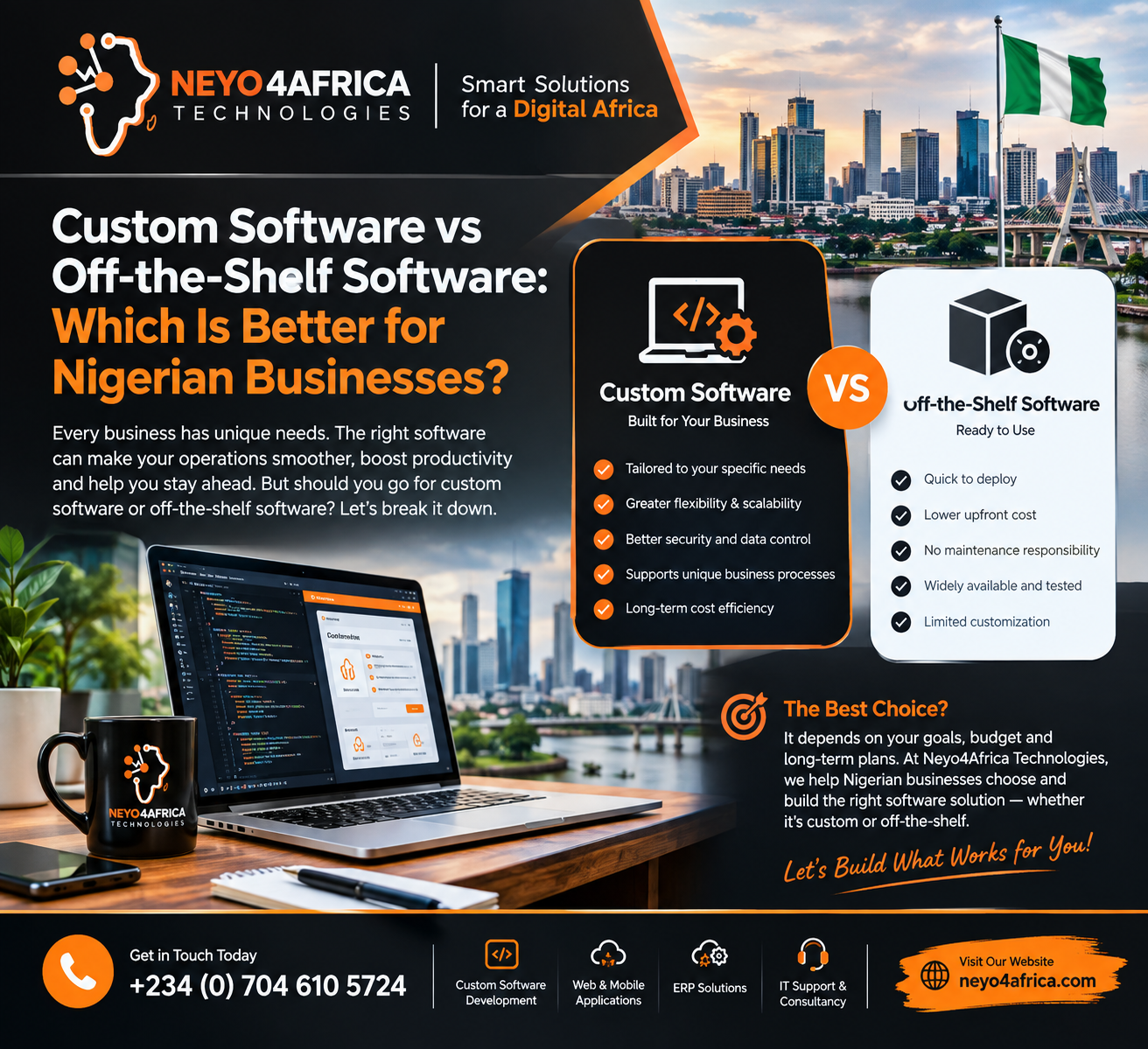
10. Consider Custom Software for Specific Needs
Off-the-shelf software is useful when it already supports your business processes. However, some businesses have requirements that standard products cannot adequately handle.
Custom software may be appropriate when a business needs:
- Specialized workflows
- Multiple departments using one system
- Integration with existing applications
- Custom approval processes
- A centralized management dashboard
- Industry-specific reporting
- A customer or supplier portal
For example, a company managing sales, stock, staff, suppliers and branches may benefit from a unified business management system if separate tools are creating unnecessary duplication.
Custom software should not be the first choice simply because it sounds advanced. Compare the cost, maintenance requirements and available alternatives before deciding.
For more information, read our guide on how much custom software development costs in Nigeria.
You can also learn how to choose a software development company in Nigeria before engaging a developer.
How Much Does It Cost to Digitize a Business in Nigeria?
There is no single price because businesses have different requirements and levels of complexity.
A business may start with existing tools and low-cost subscriptions, while another may need paid software, integrations, staff training or a custom application.
The main cost factors include:
- Number of users
- Features required
- Software subscription fees
- Devices and equipment
- Internet and connectivity
- Data migration
- Integration with existing systems
- Employee training
- Hosting and maintenance
- Security and backups
Before spending money, identify the business problem and estimate the value of solving it.
For example, if a process takes several hours each week, calculate the time spent, the errors involved and the cost of delays. Use this information to compare available solutions.
A sensible approach is to start with essential features, measure the results and expand when there is a clear business need.
Common Mistakes to Avoid
Buying Software Without a Clear Objective
Do not invest in a tool simply because another business uses it. Identify the problem you want to solve first.
Digitizing a Poorly Organized Process
Moving a confusing manual process into software may simply make the confusion digital. Review and simplify the workflow before automating it.
Choosing Too Many Tools
Using separate applications that do not communicate with one another can create duplicated work. Choose tools that fit together where integration is necessary.
Ignoring Employee Training
Employees need to understand how and why a new system should be used. Provide practical training and clear instructions.
Neglecting Security
Use strong authentication, appropriate access controls, reliable backups and software updates.
Failing to Measure Results
Set clear objectives and review whether the new system is saving time, improving accuracy or making service delivery better.
A Practical Digital Transformation Roadmap
Nigerian businesses do not need to digitize everything at once. A phased approach can make the transition more manageable.
  Identify manual processes, recurring errors, delays and areas where information is difficult to access.
</box>

  Choose one or two high-impact problems, such as sales tracking, inventory or customer records.
</box>

  Select suitable tools, organize existing records, train employees and test the new workflow.
</box>

  Review performance, resolve problems and expand to other operations when the first improvements are working.
</box>
Useful measurements may include time spent on administrative work, transaction errors, stock discrepancies, customer response times and the time required to prepare reports.
Which Nigerian Businesses Can Benefit From Digitization?
Almost any business that manages customers, transactions, records or repeated workflows can benefit from suitable digital tools.
Examples include:
- Retail businesses: sales, inventory and customer records
- Schools: student information, fees, attendance and results
- Hospitals and clinics: appointments, records and administrative workflows
- Logistics companies: deliveries, tracking and dispatch
- Real estate businesses: property listings, enquiries and client follow-ups
- Professional services: bookings, invoices and project management
- Manufacturers: inventory, production records and procurement
- Hospitality businesses: reservations, customer service and payments
The appropriate solution depends on the organization's size, industry, budget and operating requirements.
Final Thoughts
Digitizing business operations is not about adopting every new technology. It is about using the right tools to solve real problems.
For Nigerian businesses, a good starting point is to identify where manual work causes delays, errors or unnecessary expenses. Then choose a practical solution, train the people who will use it and measure the results.
Start small, protect your data and expand gradually as your needs become clearer.
The most effective digital transformation is one that makes your business easier to manage, improves the customer experience and supports sustainable growth.
Need Help Digitizing Your Business?
Neyo4Africa provides technology and software development solutions for businesses and organizations looking to improve their operations through digital tools.
Whether you need a business management system, custom web application, inventory solution, administrative dashboard or an integrated digital platform, begin with a clear understanding of your operational challenges.
Contact Neyo4Africa to discuss your business requirements and explore a suitable digital solution.
What Would You Digitize First?
If you could improve just one part of your business operations, would you choose sales, inventory, accounting, customer management or employee administration?
Share your answer in the comments.

















No comments yet
Be the first to share your thoughts on this article.