
Online learning has created new opportunities for schools, tutors, training centres, and businesses to deliver educational content beyond the traditional classroom. With an online learning platform, students can access lessons, complete assessments, track their progress, and learn from different locations.
For Nigerian educators and entrepreneurs, building an online learning platform can provide a way to reach more learners, offer flexible training, and organize educational services digitally.
However, developing a successful platform involves more than uploading videos to a website. You need to plan the learning experience, choose suitable technology, manage courses and users, and create a reliable system for delivering educational content.
So, how do you build an online learning platform in Nigeria, and what features should it include?
This guide explains the process, from planning your idea to launching and improving your platform.
What Is an Online Learning Platform?
An online learning platform is a digital system that allows instructors or organizations to provide educational content and enables learners to access courses through the internet.
Depending on its purpose, the platform may support video lessons, downloadable materials, online tests, student registration, certificates, payments, progress tracking, and communication between instructors and learners.
Examples of online learning platforms include systems designed for:
- Schools and educational institutions.
- Private tutors and independent instructors.
- ICT and professional training centres.
- Corporate employee training.
- Professional certification programmes.
- Online course businesses.
- Educational marketplaces where multiple instructors offer courses.
For example, a Nigerian ICT training centre could build a platform where students register for Python, web development, or digital skills courses, access lessons, complete assignments, and monitor their progress without attending every lesson physically.
1. Define the Purpose of Your Online Learning Platform
Before choosing a developer or purchasing software, determine what you want the platform to achieve.
A clear purpose helps you identify the features you need and avoid spending money on functionality that does not support your goals.
Start by answering these questions:
- Who will use the platform?
- What subjects or courses will it offer?
- Will courses be free, paid, or both?
- Will lessons be live, recorded, or a combination?
- Will you teach the courses yourself or allow other instructors to register?
- Will learners receive certificates after completing courses?
- Will the platform serve individuals, schools, or businesses?
Your answers will influence the platform's structure and development requirements.
For instance, a platform for one training centre may only need an administrator, instructors, and students. A marketplace that allows independent instructors to sell courses may require additional features such as instructor dashboards, commission management, and payout tracking.
2. Choose the Type of Learning Platform You Want to Build
Not every online learning platform needs the same features.
Learning Management System (LMS)
An LMS helps organizations create, organize, deliver, and manage educational content.
It commonly includes course management, student enrolment, assessments, progress tracking, and instructor tools.
An LMS is suitable for schools, training centres, and organizations that want to manage structured learning programmes.
Online Course Website
An online course website allows an individual or organization to publish courses that learners can access online.
It may include course descriptions, registration, payment processing, recorded lessons, and downloadable resources.
This option is useful for tutors, consultants, and training businesses that want to sell their knowledge online.
Multi-Instructor Learning Marketplace
A learning marketplace allows different instructors to create and offer courses through one platform.
In addition to student and course management, it may require instructor registration, course approval, revenue sharing, commission calculations, and payout management.
This model generally requires more planning and development than a platform managed by a single training provider.
Live Online Learning Platform
A live learning platform focuses on real-time classes, webinars, virtual classrooms, and instructor-student interaction.
It may integrate with video-conferencing services or use other live-streaming technology, depending on the requirements.
Choosing the right model early helps determine your budget, development timeline, and technical requirements.
3. Identify the Essential Features
The features you include will determine how learners interact with the platform and how administrators manage educational activities.
Student registration and login
Students should be able to create accounts, log in securely, manage their profiles, and access courses for which they are eligible.
Password recovery and appropriate access controls are also important.
Course management
Administrators or authorized instructors need tools to create courses, organize lessons, upload learning materials, and update course information.
Courses may be divided into modules and lessons so students can follow a clear learning path.
Video lessons and learning materials
The platform should support the delivery of educational content, such as recorded videos, presentations, documents, audio, and downloadable resources.
For a platform serving learners with limited internet bandwidth, consider video compression, adjustable playback quality, and efficient file delivery.
Online assessments and quizzes
Quizzes and assignments help instructors evaluate whether students understand the material.
Depending on the learning model, the platform may support automatic grading, instructor-marked assignments, feedback, and assessment history.
Student progress tracking
Students should be able to see their course progress and identify lessons they have completed or still need to study.
Administrators and instructors may also need reports showing enrolment, course completion, and assessment performance.
Payment integration
If courses are paid, the platform may need to support online payments, enrolment after successful payment, transaction records, and payment confirmations.
For a Nigerian audience, suitable payment options may include providers such as Paystack or Flutterwave, depending on the business's eligibility and requirements.
Certificates
Some platforms issue certificates after learners complete courses or meet specified assessment requirements.
If certificates are included, the system should define the conditions for earning them and provide a reliable way to verify their authenticity.
Administrative dashboard
The administrator dashboard provides a central place to manage users, courses, payments, content, and platform settings.
The features available should reflect the responsibilities of administrators, instructors, and other authorized users.
Notifications and communication
Email notifications or other appropriate messaging integrations can inform learners about enrolment, new lessons, assignments, deadlines, and important course updates.
Mobile-friendly design
Learners may access courses from smartphones, tablets, or computers. The platform should therefore work well across screen sizes and remain easy to navigate.
A mobile-friendly website is often a practical starting point before investing in a separate mobile application.
4. Choose the Right Technology
The technology stack determines how the platform is built, maintained, and expanded.
The right choice depends on your budget, technical requirements, development team, and long-term plans.
Technology or approachPossible use
WordPress with an LMS plugin | Launching a course website with established learning features
Laravel (PHP) | Developing customized learning platforms and administrative systems
Django (Python) | Building learning applications using Python
Node.js | Developing server-side services and interactive applications
MySQL or PostgreSQL | Storing users, courses, enrolments, assessments, and transactions
Cloud or managed hosting | Hosting the application and supporting its operational needs
Video hosting or streaming services | Delivering lessons without relying entirely on the main web server
These technologies are examples, not a requirement to use them all together.
For a simple course website, an existing LMS solution may be sufficient. If the business requires unique workflows, complex integrations, or specialized dashboards, custom software development may be more suitable.
Neyo4Africa Technologies works with software development technologies including Laravel and Python. The final stack should be selected according to the project's requirements rather than popularity alone.
5. Plan the Database and User Roles
A learning platform stores information about users, courses, lessons, enrolments, assessments, payments, and learning progress.
The database should organize these records so that information can be retrieved accurately and securely.
A typical platform may have three main user roles.
Administrator: Manages the platform, users, course approvals, settings, and reports.
Instructor: Creates or manages assigned courses, uploads lessons, reviews submissions, and provides feedback.
Student: Enrols in courses, accesses lessons, completes assessments, and checks progress.
A multi-instructor marketplace may require additional roles and financial workflows.
Permissions should be designed carefully so users can access only the information and functions appropriate to their roles. For example, students should not be able to edit another student's assessment results or access restricted administrative functions.
6. Design a Simple and Effective User Experience
A learning platform should make it easy for students to find courses, understand what they will learn, and continue their lessons.
Before development, plan the main pages and how users will move between them.
Important pages may include:
- Homepage.
- Course catalogue.
- Individual course details.
- Registration and login.
- Student dashboard.
- Course learning page.
- Quizzes and assignments.
- Payment and enrolment pages.
- Instructor dashboard.
- Administrator dashboard.
- Help and contact pages.
Use clear navigation, readable text, consistent layouts, and visible progress indicators.
Accessibility should also be considered. Captions, meaningful headings, keyboard navigation, and readable colour contrast can make learning content more accessible to a wider range of users.
7. Develop the Platform in Stages
Building the platform in stages can help you control costs and test the most important features before expanding the system.
Stage 1: Requirements and planning
Document the platform's purpose, target audience, user roles, course structure, payment model, and required features.
Prepare a clear project scope so the development team understands what must be delivered.
Stage 2: Design and prototyping
Create sample layouts and user flows for the homepage, course pages, student dashboard, and other essential screens.
Review the design before proceeding to full development.
Stage 3: Backend development
Build the server-side functionality, database structure, authentication, course management, enrolment logic, and other required services.
Stage 4: Frontend development
Implement the pages and interfaces students, instructors, and administrators will use.
Ensure that the platform is responsive and that the learning experience works across common devices.
Stage 5: Integrations
Configure the required payment services, email notifications, video delivery, or other external services.
Test each integration to confirm that it behaves correctly under normal and error conditions.
Stage 6: Testing
Test registration, login, course enrolment, payments, assessments, permissions, and progress tracking.
Also test mobile layouts, loading performance, error handling, backups, and security controls.
Stage 7: Launch
Deploy the application to its production environment, configure the domain and security certificates, verify essential functions, and prepare support procedures.
Begin with a manageable number of courses and users if you want to validate the learning experience before expanding.
Stage 8: Maintenance and improvement
After launch, monitor performance, collect user feedback, fix defects, update dependencies, and improve features based on actual learner needs.
A learning platform is an ongoing service, not just a one-time development project.
8. How Much Does It Cost to Build an Online Learning Platform in Nigeria?
The cost depends on whether you use an existing LMS, customize a ready-made solution, or develop a platform from the ground up.
The number of users, course-delivery requirements, payment integrations, assessment features, reporting needs, and expected traffic can all influence the budget.
Type of platformMain cost considerations
Basic course website | Theme or setup, essential course pages, user registration, and hosting
LMS with student dashboards | Course management, enrolment, quizzes, progress tracking, and administration
Customized learning platform | Custom workflows, integrations, reporting, and tailored user interfaces
Multi-instructor marketplace | Instructor onboarding, course approval, commissions, payouts, and additional financial controls
Large-scale learning platform | Infrastructure, performance engineering, security, monitoring, and ongoing maintenance
These categories are intended for planning, not fixed price quotations. Actual costs should be based on a documented feature list and written development proposal.
Before requesting a quotation, identify your essential features, expected number of learners, content-delivery approach, and preferred payment model.
You should also budget for ongoing expenses such as:
- Domain registration and hosting.
- Video storage or streaming.
- Email and notification services.
- Payment processing fees.
- Maintenance and security updates.
- Technical support.
- Course creation and content production.
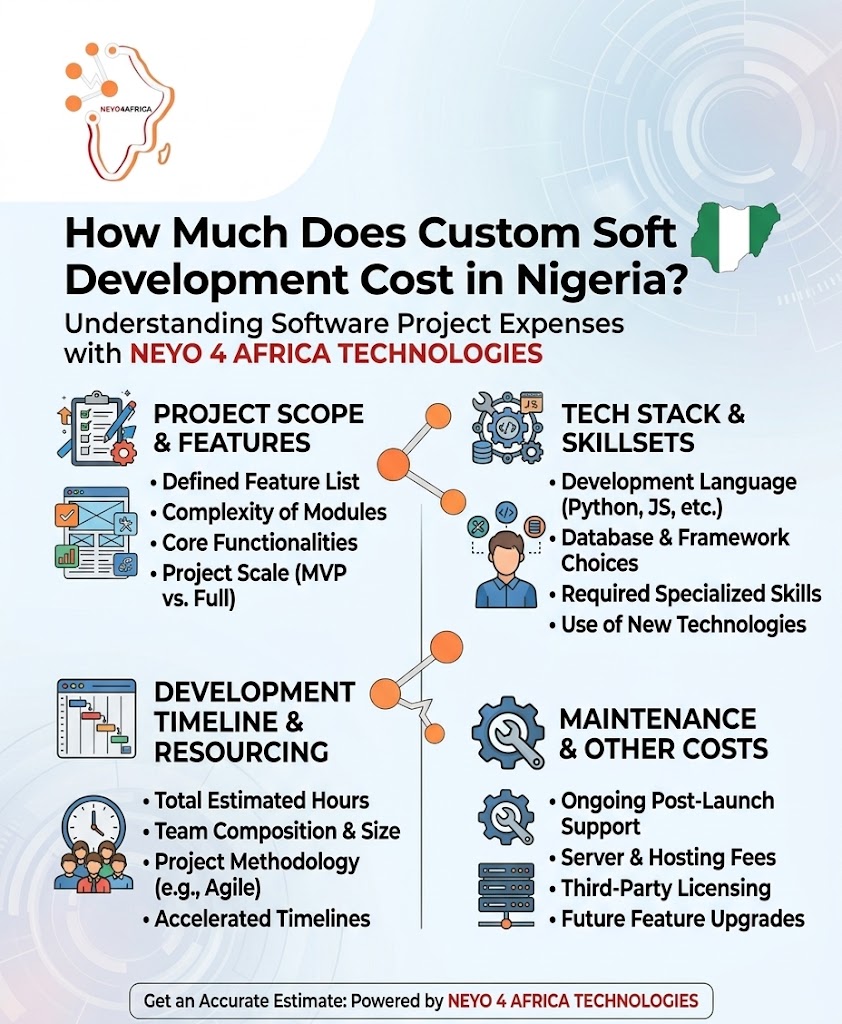
For a broader understanding of development budgeting, read our related article, How Much Does Custom Software Development Cost in Nigeria?
9. How Long Does It Take to Build an Online Learning Platform?
The timeline depends on the project's complexity, the availability of content and design decisions, the number of integrations, and the testing required.
A basic course website using an existing LMS may be ready in a matter of weeks. A customized platform may take several weeks to a few months, while a large marketplace with complex features may require several months or longer.
The development schedule should account for requirements, design, implementation, testing, content preparation, deployment, and revisions.
To reduce delays, prepare course materials early, approve designs promptly, and agree on the project's scope before development begins.
10. Security and Data Protection Considerations
Learning platforms may store personal details, course records, assessment results, and payment-related information. Protecting these records is an important part of development.
Consider implementing:
- Secure authentication and appropriate password handling.
- Role-based access permissions.
- HTTPS for data transmitted between users and the website.
- Regular backups and a tested recovery process.
- Software updates and security testing.
- Protection against common web application vulnerabilities.
- Secure payment integrations that avoid unnecessary storage of sensitive payment details.
- Clear privacy notices and responsible data-handling procedures.
If the platform serves users in Nigeria, review the applicable Nigerian data protection requirements and obtain appropriate guidance where necessary.
Security should be considered from the beginning rather than added only after the platform is launched.
11. Common Mistakes to Avoid
When planning an online learning platform, avoid these mistakes:
Building too many features at the beginning. Start with the functions needed to deliver and manage courses effectively.
Ignoring mobile users. Test the platform on smartphones as well as desktop computers.
Using an unsuitable video-delivery approach. Large video files can consume storage and bandwidth. Choose a delivery method that fits your content and expected audience.
Neglecting student feedback. Confusing navigation or difficult enrolment can discourage learners. Test the experience with real users.
Overlooking ongoing costs. Hosting, streaming, maintenance, support, and content creation may continue after development is complete.
Failing to test payment and enrolment flows. Confirm that successful payments, failed transactions, refunds where applicable, and course access are handled correctly.
Launching without a content plan. A technically functional platform still needs useful courses, clear learning objectives, and a plan for keeping content relevant.
Treating security as optional. User accounts, course records, and administrative functions need appropriate protection.
12. How to Make Your Online Learning Platform Successful
A successful learning platform needs more than software. It needs valuable educational content and a good experience for both students and instructors.
Start by offering courses that address specific learning needs. Organize each course into clear lessons with practical exercises and assessments where appropriate.
Make it easy for students to understand the course objectives, expected duration, prerequisites, and completion requirements.
Gather feedback from early users and use it to improve course content, navigation, technical performance, and support.
You should also develop a marketing strategy. Depending on your audience, this may include search engine optimization, educational articles, email newsletters, social media, partnerships, and demonstrations of your courses.
Track useful indicators such as enrolments, course completion, returning learners, learner feedback, and payment issues. These measures can help you identify what is working and what needs improvement.
Build Your Online Learning Platform with Neyo4Africa Technologies
If you are a school owner, tutor, training centre, or entrepreneur planning to deliver courses online, the right platform can help you organize educational content and serve learners more effectively.
Neyo4Africa Technologies provides software development services for businesses and organizations that need digital solutions tailored to their requirements.
Depending on your project, an online learning platform may include student registration, course management, video lessons, assessments, payment integration, certificates, and administrative dashboards.
Before development begins, define your learning model, target audience, essential features, and budget. This helps establish a clear project scope and makes it easier to compare development proposals.
Explore our Software Development Services to learn more about developing digital solutions for your organization.
You can also visit our Training Programmes to explore technology courses offered by Neyo4Africa.
Frequently Asked Questions
Can I build an online learning platform without coding?
Yes. Existing learning management systems and website platforms can help you launch without building every feature from scratch. Custom development may be more appropriate if your requirements go beyond the capabilities of available tools.
Can I build an online learning platform using Laravel?
Yes. Laravel can be used to develop a customized learning platform with features such as user authentication, course management, enrolment, assessments, payments, and administrative dashboards. The required functionality depends on the project's scope.
Do I need a mobile app for my learning platform?
Not necessarily. A responsive website can provide a practical starting point for learners using smartphones and computers. A dedicated mobile application can be considered later if offline learning, device-specific features, or other requirements justify it.
How can an online learning platform make money?
Possible revenue models include selling individual courses, offering subscriptions, charging for instructor-led programmes, providing corporate training, or operating a multi-instructor marketplace. The appropriate model depends on the target audience and educational offering.
Can students receive certificates online?
Yes. A platform can generate digital certificates when learners satisfy specified course-completion or assessment requirements. You should define these requirements clearly and consider adding certificate verification.
How do I protect my course videos from unauthorized access?
You can use authenticated access, restricted video delivery, expiring links, and appropriate hosting or streaming controls. No method can guarantee that digital content will never be copied, so combine technical protections with clear terms of use and reasonable access policies.
Conclusion
Building an online learning platform in Nigeria begins with understanding your learners and defining the kind of educational experience you want to provide.
Choose an appropriate platform, prioritize essential features, plan your database and user roles, test the learning experience, and budget for hosting, security, maintenance, and content delivery.
You do not have to build every possible feature at once. Start with a focused version that delivers real value, gather feedback, and expand as your needs grow.
Are you planning to build an online learning platform for a school, training centre, or online course business? Which features would be most important to you? Share your thoughts in the comments.














No comments yet
Be the first to share your thoughts on this article.