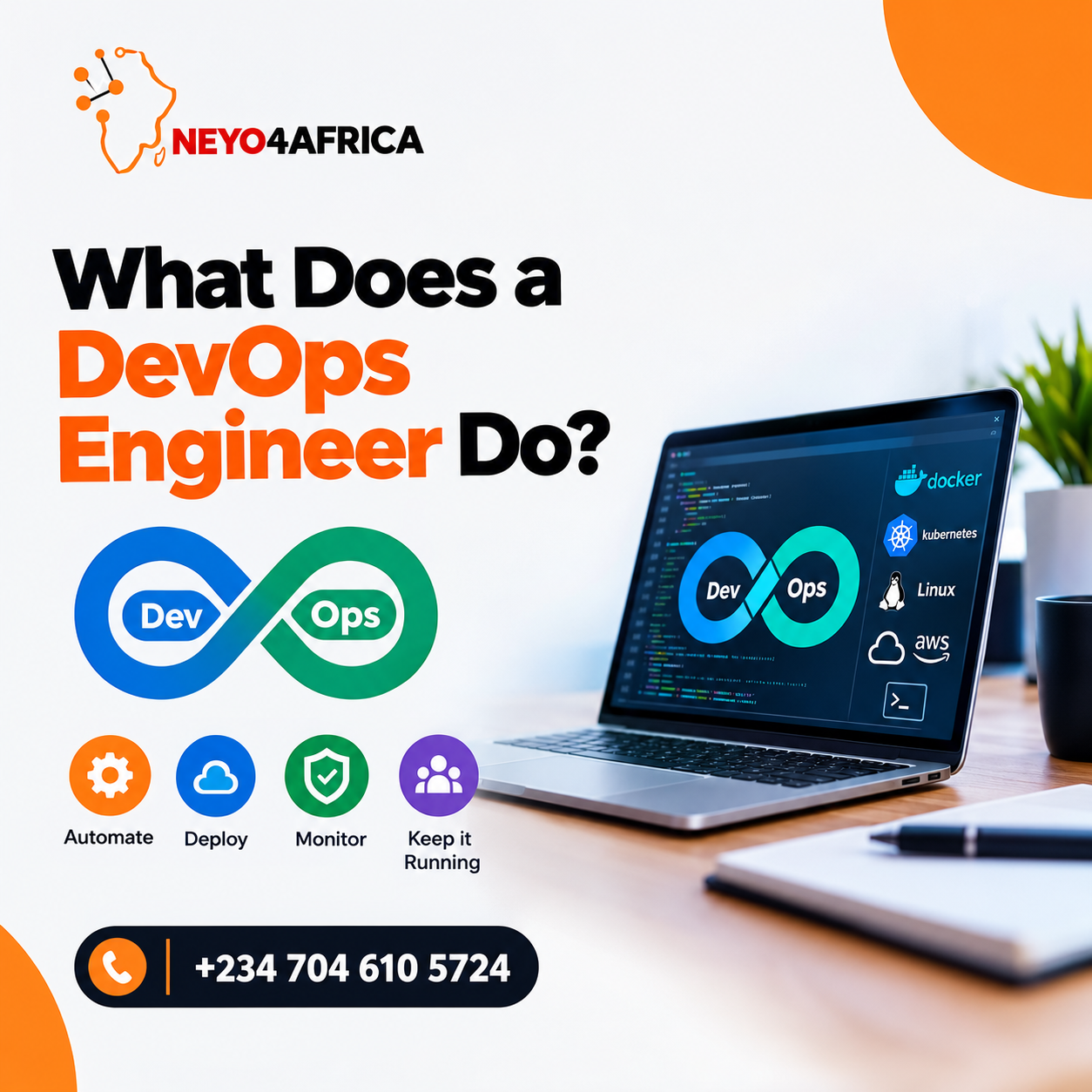
Technology companies need more than developers who can write code. They also need professionals who can help applications run reliably, deploy updates safely, manage infrastructure, and resolve technical problems. This is where a DevOps engineer comes in.
As businesses in Nigeria continue to adopt websites, mobile applications, cloud platforms, and digital services, understanding DevOps can help aspiring technology professionals explore another career path in the software industry.
In this guide, you will learn what a DevOps engineer does, the tools they use, the skills required, and how beginners in Nigeria can start learning DevOps.
What Is a DevOps Engineer?
A DevOps engineer is a technology professional who helps software development and IT operations teams work together to build, test, deploy, and maintain applications more efficiently.
The word DevOps combines two terms:
- Development (Dev): Creating and improving software applications.
- Operations (Ops): Managing the systems, servers, infrastructure, and environments that run those applications.
A DevOps engineer helps connect these two areas through automation, collaboration, monitoring, and reliable software delivery. The goal is to help teams release updates more consistently while maintaining application performance and security.
According to Microsoft Learn, DevOps includes practices such as continuous integration, automated testing, continuous delivery, infrastructure management, security, and monitoring.
What Does a DevOps Engineer Do Every Day?
The daily responsibilities of a DevOps engineer depend on the organisation and its technology stack. However, the role commonly includes the following tasks.
1. Automates Software Deployment
Deploying software manually can be slow and prone to mistakes. DevOps engineers automate deployment processes so tested application updates can move through the required environments more consistently.
For example, when a developer updates a company's website, a deployment pipeline can run checks and prepare the update for release without requiring every step to be performed manually.
2. Builds CI/CD Pipelines
CI/CD stands for Continuous Integration and Continuous Delivery or Continuous Deployment.
- Continuous Integration (CI): Automatically builds and tests code when developers submit changes.
- Continuous Delivery: Keeps tested changes ready for release through a controlled process.
- Continuous Deployment: Automatically releases changes that pass the required checks into production.
DevOps engineers configure tools such as GitHub Actions and Jenkins to automate parts of this process.
3. Manages Cloud Infrastructure
Many applications run on cloud platforms instead of relying entirely on physical servers within an organisation.
DevOps engineers may configure and manage infrastructure using platforms such as Amazon Web Services (AWS), Microsoft Azure, or Google Cloud.
Their work can include managing servers, storage, networking, permissions, backups, and resources needed to run applications.
4. Uses Containers and Container Orchestration
Applications may behave differently across development, testing, and production environments. Containers help package an application and its dependencies in a consistent way.
DevOps engineers commonly work with:
- Docker: Packages applications and their dependencies into containers.
- Kubernetes: Helps deploy, manage, and scale containerised applications across a cluster of machines.
Beginners do not need to master Kubernetes immediately. Learning basic Linux, Git, networking, and Docker first provides a stronger foundation.
5. Monitors Applications and Fixes Problems
After an application is deployed, the work does not end. DevOps engineers monitor its performance, availability, logs, and resource usage.
They investigate problems such as slow response times, failed deployments, server errors, and unexpected increases in resource consumption.
Monitoring tools help teams identify issues and respond before they significantly affect users.
6. Improves Security and Reliability
DevOps engineers help protect applications and infrastructure by managing access permissions, securing deployment pipelines, protecting credentials, applying updates, and integrating security checks into software delivery.
They also work with developers and security teams to reduce risks and improve recovery when something goes wrong.
7. Works with Developers and Other Teams
DevOps is not just about tools. It also involves communication and teamwork.
DevOps engineers collaborate with software developers, testers, system administrators, cloud engineers, and security professionals to make software delivery more predictable and efficient.
Common Tools Used by DevOps Engineers
DevOps engineers do not use every tool available. The tools they choose depend on their projects, cloud provider, and organisation.
Tool or technologyWhat it is used for
Linux | Managing servers and working with command-line tools
Git and GitHub | Tracking code changes and collaborating
GitHub Actions or Jenkins | Automating builds, tests, and deployments
Docker | Packaging applications into containers
Kubernetes | Managing containerised applications at scale
AWS, Azure, or Google Cloud | Providing cloud infrastructure and services
Terraform | Defining and managing infrastructure through code
Ansible | Automating system configuration and administration
Prometheus and Grafana | Monitoring system metrics and displaying dashboards
Python or Bash | Writing scripts to automate repetitive tasks
You do not need to learn all these tools at once. Start with the fundamentals and add tools as your skills improve.
What Skills Does a DevOps Engineer Need?
To build a strong foundation in DevOps, focus on these areas:
1. Linux and operating systems: Learn how to navigate the terminal, manage files and permissions, inspect processes, and troubleshoot common problems.
2. Networking fundamentals: Understand IP addresses, DNS, ports, HTTP/HTTPS, firewalls, and how computers communicate.
3. Git and version control: Learn how to track changes, create branches, merge work, and collaborate using GitHub.
4. Scripting: Learn basic Bash or Python to automate repetitive tasks.
5. CI/CD: Understand how code is built, tested, and delivered using automated pipelines.
6. Cloud computing: Learn how cloud servers, storage, networking, identity permissions, and monitoring work.
7. Containers: Understand Docker before progressing to more advanced container orchestration.
8. Security and troubleshooting: Learn to protect credentials, apply appropriate access controls, read logs, and investigate failures.
9. Communication and problem-solving: Be able to explain technical issues, document solutions, and collaborate with other teams.
How Can You Become a DevOps Engineer in Nigeria?
You can begin learning DevOps without having a computer science degree. However, the role requires practical technical knowledge, and becoming job-ready takes consistent study and hands-on experience.
Here is a practical learning roadmap for beginners.
Step 1: Learn the Basics of Computing and Networking
Understand operating systems, servers, IP addresses, DNS, web requests, and basic networking concepts.
If you are new to technology, begin with computer fundamentals before moving into server administration.
Step 2: Learn Linux and the Command Line
Practise using the terminal to create files, manage permissions, inspect processes, install software, and troubleshoot errors.
These skills will help you understand how many production servers operate.
Step 3: Learn Git and GitHub
Create a GitHub account and practise saving code, managing branches, and collaborating on projects.
You can start with a simple website or a basic Python application.
Step 4: Learn Basic Scripting
Start with Bash or Python. Focus on variables, conditions, loops, functions, files, and scripts that automate small tasks.
You do not have to become an advanced software developer before starting with DevOps, but programming knowledge is valuable.
Step 5: Build Your First CI/CD Pipeline
Create a small application and configure a pipeline using GitHub Actions or Jenkins. Start by running automated checks whenever you push a code change.
Then learn how to deploy the application to a test environment.
Step 6: Learn Cloud Computing and Docker
Choose one cloud platform to study first. Practise creating and managing basic cloud resources, understanding access permissions, and deploying an application.
Next, learn Docker and how containers help applications run consistently across environments.
Step 7: Build Practical Projects
Practical experience helps you demonstrate what you know. Document your work and share appropriate code and configuration files on GitHub without exposing passwords, API keys, or other secrets.
Beginner DevOps Projects to Add to Your Portfolio
Try these projects as you progress:
- Automated website deployment: Build a basic website and use GitHub Actions to automate its deployment.
- Dockerised web application: Package a simple Node.js, Python, or PHP application using Docker.
- Cloud-hosted application: Deploy a small application to a cloud environment and configure basic access controls.
- Monitoring dashboard: Collect basic application or server metrics and display them in Grafana.
- Infrastructure as Code: Use Terraform to define and manage a small test environment.
- Automated backup script: Write a Bash or Python script that performs a backup and logs the result.
These projects help you practise real tasks associated with DevOps work. Start small and explain the problem each project solves, the tools you used, and how you tested the result.
Where Can DevOps Engineers Work in Nigeria?
DevOps skills can be relevant to organisations that develop, host, or maintain digital services, including:
- Fintech and financial services companies.
- Software development companies and technology startups.
- Telecommunications and internet service providers.
- E-commerce and online service businesses.
- Cloud service providers and IT consulting firms.
- Large organisations operating internal software platforms.
Some roles may be based in an office, while others may offer hybrid or remote work. Requirements vary by employer, and remote positions may attract applicants from several countries.
What Is the Difference Between a DevOps Engineer and a Software Developer?
Although the roles work closely together, their main responsibilities are different.
Software developerDevOps engineer
Builds application features and business logic | Automates software delivery and manages supporting infrastructure
Writes application code | Writes scripts, pipeline configurations, and infrastructure code
Tests and improves application functionality | Helps automate testing, deployment, monitoring, and recovery
Focuses mainly on what the application does | Focuses heavily on how the application is delivered and operated reliably
These responsibilities can overlap. In smaller organisations, a software developer may also handle deployment and infrastructure tasks.
Is DevOps a Good Career to Consider in Nigeria?
DevOps may be worth exploring if you enjoy solving technical problems, automating repetitive work, understanding how systems operate, and helping applications remain reliable.
It is particularly relevant to people interested in cloud computing, system administration, networking, and software engineering.
However, it is not a shortcut to an immediate technology job. Employers may expect practical experience with Linux, cloud platforms, automation, troubleshooting, and deployment tools. Building projects and learning how to explain your technical decisions can help you prepare for entry-level opportunities.
Frequently Asked Questions
Can I learn DevOps without knowing programming?
Yes. You can begin with Linux, networking, and Git before learning basic Bash or Python. Programming and scripting become increasingly useful as you automate more complex tasks.
How long does it take to learn DevOps?
The timeline depends on your starting point, study schedule, and practical experience. You may learn basic concepts in a few months, but developing the skills needed for a professional role can take considerably longer. Consistent hands-on practice is essential.
Do DevOps engineers need cloud computing skills?
Cloud skills are valuable because many organisations run applications on cloud infrastructure. Some DevOps roles focus on cloud platforms, while others work with on-premises or hybrid environments.
Which programming language is best for DevOps?
Python and Bash are useful starting points for automation. The best choice depends on the tasks you need to perform and the tools used by your target employers.
Do I need certifications to become a DevOps engineer?
Certifications can help demonstrate knowledge of particular platforms, but they do not replace practical experience. Begin with foundational skills and projects before deciding whether a cloud or DevOps certification fits your career goals.
Start Building Your Technology Skills with Neyo4Africa
DevOps engineering brings together software development, automation, cloud computing, security, and infrastructure management. By learning the fundamentals and practising with real projects, beginners can gradually build the knowledge required to explore this career path.
If you want to strengthen your software development foundation before progressing into automation and cloud technologies, explore the learning opportunities available through Neyo4Africa Technologies.
Visit our training programmes to explore available courses, or review our software development services to learn more about the software solutions we provide.
What interests you most about DevOps: cloud computing, automation, or deploying applications? Share your thoughts in the comments.


















No comments yet
Be the first to share your thoughts on this article.