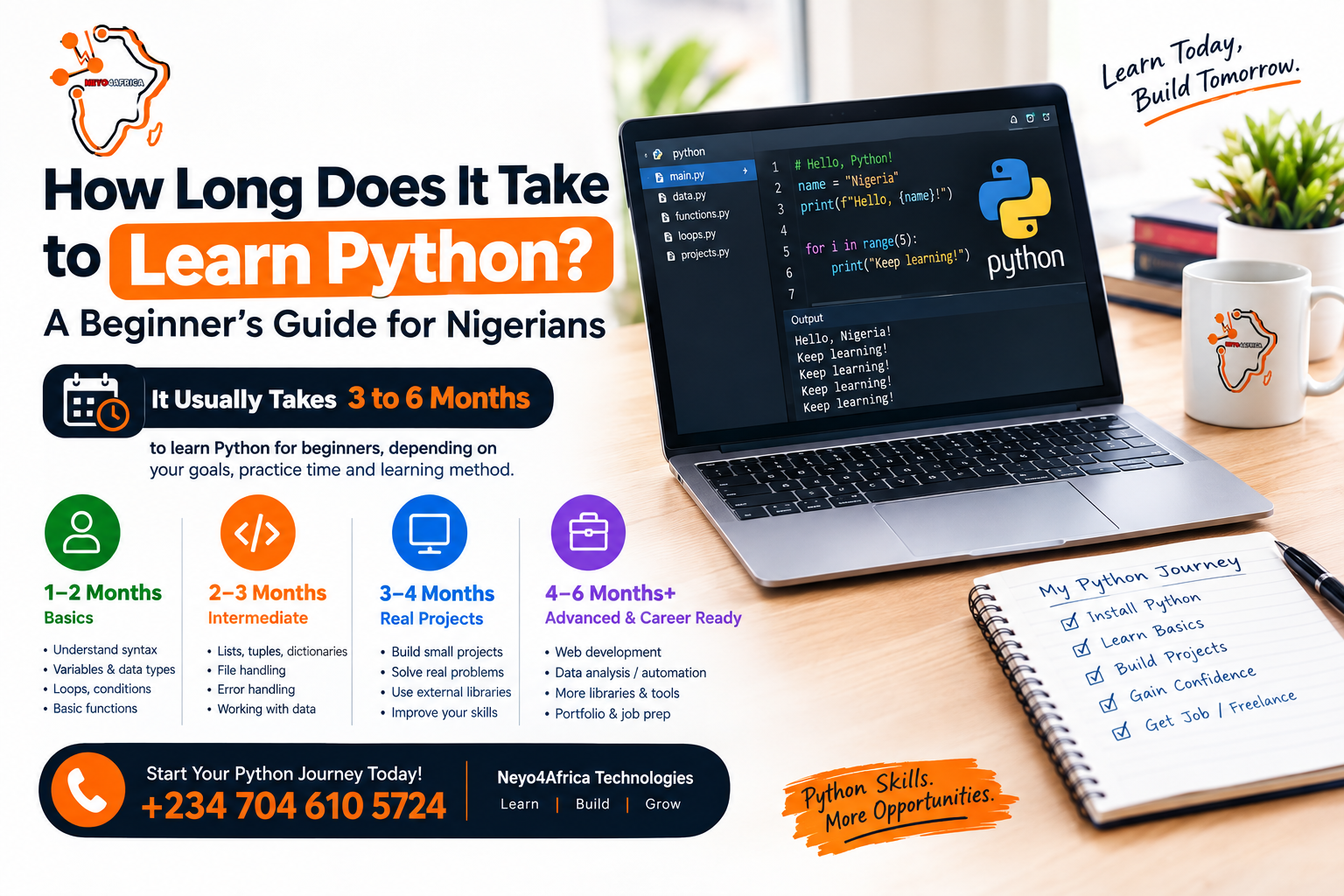
Python is one of the programming languages beginners can consider when starting a career in software development. It is used in web development, automation, data analysis, artificial intelligence, and many other areas of technology.
However, one question many beginners ask before starting is: How long does it take to learn Python?
The answer depends on how much time you dedicate to learning, your previous experience with computers or programming, the learning resources you use, and what you want to achieve.
Some learners can understand basic Python concepts within a few weeks, while building practical applications and developing job-ready skills may take several months or longer.
In this guide, we explain how long it may take to learn Python, the topics you should study, the projects you can build, and how beginners in Nigeria can develop their programming skills step by step.
How Long Does It Take to Learn Python?
For someone starting from scratch, learning Python fundamentals may take approximately 4–8 weeks with consistent practice. Building practical projects may take around 2–4 months, while developing the skills required for an entry-level role can take 6–12 months or longer.
These are general planning estimates, not guarantees. Your progress will depend on your learning schedule, the complexity of your goals, and how consistently you practise.
Here is a simple breakdown.
Learning stageEstimated timeWhat you may be able to do
Python fundamentals | 4–8 weeks | Understand variables, data types, conditions, loops, and functions
Beginner projects | 2–4 months | Build calculators, simple games, and basic record-management programs
Intermediate Python | 3–6 months | Work with files, modules, APIs, exceptions, and more structured programs
Web development or another specialization | 4–9 months or more | Begin building applications in a chosen area
Entry-level job preparation | 6–12 months or longer | Develop a portfolio, practise problem-solving, and prepare for technical interviews
These stages overlap. Someone who studies consistently and builds projects from the beginning may progress faster than someone who focuses only on watching tutorials.
What Determines How Quickly You Learn Python?
1. Your previous programming experience
If you have never written code before, you will need time to understand programming concepts such as variables, conditions, loops, and functions.
If you already know another programming language, some of these concepts may be familiar, allowing you to focus on Python's syntax and features.
However, you do not need previous programming experience to start learning Python.
2. How much time you practise daily
The amount of time you spend practising can influence your progress.
For example, a learner who studies and writes code for one to two hours most days may develop practical skills sooner than someone who studies for only a short period once a week.
Consistency is more important than occasionally studying for many hours without practising afterward.
3. Your learning method
Watching videos can help you understand concepts, but programming requires hands-on practice.
You should write code, solve small problems, correct errors, and build projects. Debugging your own code is an important part of becoming a better programmer.
A useful learning routine is to spend part of each study session learning a concept, another part writing code, and the remaining time reviewing mistakes.
4. Your career goal
The time required to learn Python also depends on what you want to do with it.
Learning enough Python to automate simple tasks is different from learning Django to build web applications or developing the additional skills needed for data science and machine learning.
Choose a goal early so you can focus on the topics that matter most.
What Should You Learn First in Python?
If you are a complete beginner, follow a structured learning path rather than trying to learn everything at once.
Stage 1: Understand the basics
Start with the fundamental concepts:
- Introduction to Python and how it works.
- Installing Python and choosing a code editor.
- Variables and data types.
- Strings and numbers.
- Operators and expressions.
- Taking input and displaying output.
- Conditional statements such as if, elif, and else.
- Loops using for and while.
At this stage, focus on understanding how programs work and writing small pieces of code independently.
Stage 2: Learn essential programming concepts
Once you understand the basics, move on to:
- Functions and parameters.
- Lists, tuples, sets, and dictionaries.
- Working with strings and collections.
- File handling.
- Exception handling.
- Modules and packages.
- Basic debugging techniques.
These concepts help you organize code and build more useful programs.
Stage 3: Build beginner projects
Do not wait until you have completed every Python lesson before building projects.
Start with simple applications that allow you to apply what you have learned.
Examples include:
- A calculator.
- A number-guessing game.
- A student score management program.
- An expense tracker.
- A contact management system.
- A simple inventory tracker for a small business.
Projects help you connect individual programming concepts and develop problem-solving skills.
Stage 4: Choose an area of specialization
After learning the fundamentals, decide what you want to build with Python.
Web development: Learn Django or another suitable web framework, along with HTML, CSS, databases, HTTP, and application security.
Data analysis: Learn relevant tools such as pandas, NumPy, data visualization, and basic statistics.
Automation: Learn how to work with files, folders, spreadsheets, APIs, and repetitive computer tasks.
Artificial intelligence and machine learning: Build on your Python knowledge with mathematics, statistics, data handling, and relevant machine-learning libraries.
You do not need to master all these areas. Choose one based on your interests and career goals.
A 90-Day Python Learning Plan for Beginners
If you want a clear starting point, the following plan can help you organize your first three months.
Month 1: Learn Python fundamentals
Focus on variables, data types, operators, conditions, loops, functions, and basic data structures.
Goal: Write small programs without copying every line from a tutorial.
Month 2: Practise and build projects
Learn file handling, error handling, modules, and debugging. Build at least two or three small projects and improve them as you learn.
Goal: Use Python to solve practical problems and explain how your code works.
Month 3: Build a more complete project
Choose one project that interests you, such as a stock management system, expense tracker, or simple booking application.
Organize the code properly, handle common errors, test important functions, and document how the project works.
Goal: Complete a project that you can demonstrate to someone else.
By the end of 90 days, a consistent beginner may have a solid foundation and several small projects. This does not automatically mean they are ready for a software development job, but it gives them a useful starting point for more advanced learning.
Can You Learn Python in Three Months?
Yes, it is possible to learn Python fundamentals and build useful beginner projects within three months, particularly if you practise regularly.
However, becoming proficient enough to work independently on complex applications usually requires more time and experience.
If your goal is to become a Python developer, you will need to go beyond syntax and basic exercises. You should learn how to structure applications, use version control, work with databases, test code, debug problems, and build projects that solve real needs.
For web development with Python, you may also need to learn Django, HTML, CSS, JavaScript, database management, and deployment.
The most important measure of progress is not how quickly you finish a course, but what you can build and explain independently.
Is Python Difficult for Beginners?
Python is often considered beginner-friendly because its syntax is relatively readable compared with some other programming languages.
For example, this simple program displays a message:
print("Hello, World!")A program can also use variables and basic calculations:
name = input("What is your name? ")
age = int(input("How old are you? "))

print(f"Hello, {name}!")
print(f"Next year, you will be {age + 1}.")
These examples demonstrate basic input, output, variables, and type conversion.
However, learning Python still requires patience. Beginners may struggle with indentation, logical thinking, error messages, and breaking larger problems into smaller steps.
Making mistakes is normal. The goal is to understand why an error occurs and learn how to fix it.
Can You Get a Job After Learning Python?
Learning Python can help you work towards a software development career, but knowing the language alone may not be sufficient.
Employers generally look for evidence that you can use your skills to solve problems, work with development tools, and contribute to real projects.
Depending on your chosen career path, you may need to develop skills in:
- Problem-solving and programming fundamentals.
- Git and GitHub for version control.
- Databases and SQL.
- Application testing and debugging.
- APIs and working with external services.
- Django or another framework for web development.
- Building, documenting, and presenting projects.
Create a portfolio containing projects you have built yourself. Be ready to explain your decisions, the challenges you faced, and how you solved them.
You can also explore internships, junior developer opportunities, freelance work, and collaborative projects as you gain experience.
Should You Learn Python Online or Attend a Training Programme?
Both approaches can work, but the right option depends on your learning style and available resources.
Learning online can be flexible and affordable. You can use tutorials, documentation, exercises, and practical projects at your own pace. However, you need discipline to maintain a routine and seek help when you get stuck.
Structured training may provide a learning schedule, guided practical sessions, feedback, and support from instructors. This can be helpful if you prefer learning with a clear curriculum and deadlines.
Whichever method you choose, make sure it includes hands-on exercises, real projects, and opportunities to practise solving problems independently.
If you want a structured starting point, explore the Python course at Neyo4Africa. You can also review the available Neyo4Africa training programmes.
Common Mistakes to Avoid When Learning Python
Beginners sometimes spend months learning without developing the confidence to write programs independently. Avoid these common mistakes:
Watching tutorials without practising: Write the code yourself and experiment with changing it.
Trying to memorize everything: Focus on understanding concepts and learn how to consult reliable documentation.
Skipping the fundamentals: Frameworks are easier to understand when you know the Python concepts behind them.
Copying projects without understanding them: Rebuild parts of a project independently and explain what each section does.
Learning too many technologies at once: Start with Python fundamentals before moving into a framework or specialization.
Giving up when code fails: Read error messages, isolate the problem, test possible solutions, and learn from the result.
Waiting until you feel completely ready to build: Small projects are part of the learning process, not just the final test.
Final Thoughts: How Long Should You Give Yourself to Learn Python?
For most beginners, a reasonable plan is to spend the first one to two months learning Python fundamentals, the next few months building projects, and additional time developing skills in a chosen specialization.
You may progress faster or slower depending on your schedule, learning approach, and goals. There is no single timeline that applies to everyone.
If you are starting in Nigeria and want to build a career in technology, begin with the basics, practise consistently, and build projects that demonstrate what you can do.
Are you learning Python already, or are you planning to start? Tell us your goal and how much time you can dedicate to learning each day.













No comments yet
Be the first to share your thoughts on this article.