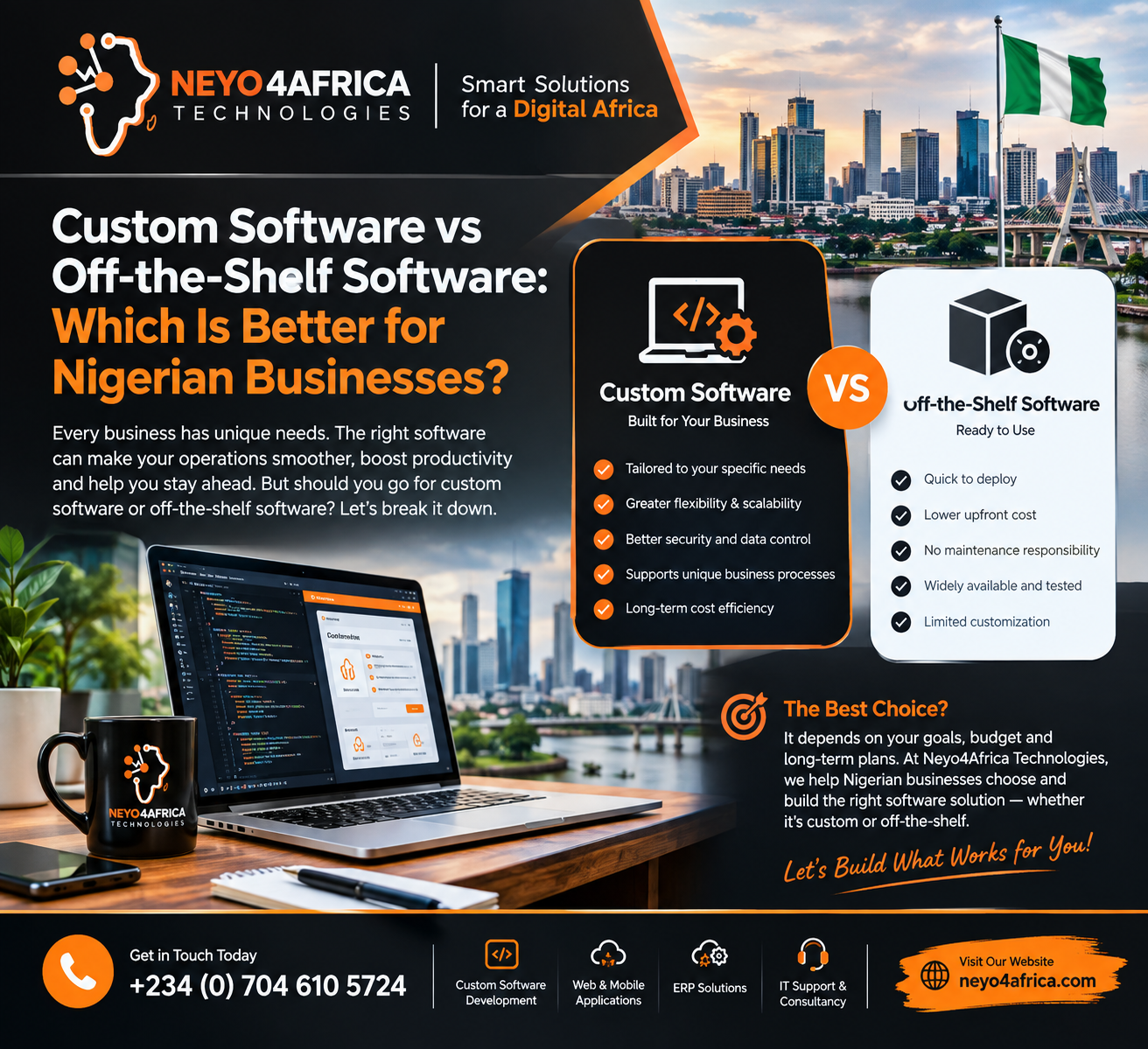
Choosing the right software can make a significant difference in how a business operates. From managing inventory and processing customer orders to tracking finances and coordinating employees, the right system can help businesses work more efficiently.
However, business owners often face an important decision: should they invest in custom software designed specifically for their operations, or use off-the-shelf software that is already available?
Both options have advantages and limitations. The right choice depends on your business needs, budget, operational processes, growth plans and the level of flexibility you require.
In this guide, we explain the differences between custom software and off-the-shelf software, their benefits, their costs and how Nigerian businesses can choose the most suitable option.
What Is Custom Software?
Custom software is an application developed or significantly tailored to meet the specific needs of a business or organisation.
Instead of adapting every business process to an existing product, the organisation can work with a software development team to define the features, workflows, integrations and reports required for its operations.
For example, a Nigerian distribution company may need software that connects inventory management, customer orders, delivery tracking, supplier records and financial reporting in one system.
If existing products cannot adequately support those requirements, custom development may be worth considering.
Custom software can include:
- Business management systems.
- Inventory and warehouse management applications.
- School management systems.
- Appointment and booking platforms.
- E-commerce applications.
- Customer relationship management systems.
- Employee and payroll management systems.
- Mobile applications for customers or employees.
The exact features depend on the project's requirements, budget and technical design.
What Is Off-the-Shelf Software?
Off-the-shelf software is a ready-made product developed for use by many customers. It usually includes standard features designed to solve common problems across different businesses.
Examples include accounting applications, project management tools, customer relationship management platforms, office productivity software and ready-made e-commerce systems.
A business can often subscribe to or purchase an existing product and configure its available settings without commissioning an entirely new application.
For example, a small business that needs to track income and expenses may be able to use an existing accounting application rather than pay for a custom accounting system.
Off-the-shelf software can reduce the need for development work, although setup, subscriptions, training, integration and ongoing support may still involve costs.
Custom Software vs Off-the-Shelf Software: Key Differences
The main difference is the degree to which the software is designed around a particular organisation's requirements.
FactorCustom softwareOff-the-shelf software
Development | Built or tailored for specific requirements | Already developed for a broader market
Initial cost | Often higher for substantial projects | Often lower to get started
Time to launch | Requires planning, development and testing | May be ready to use after setup
Features | Can be designed around business workflows | Limited to available features and configuration
Flexibility | Can be extended according to the agreed design | Depends on the provider and product
Maintenance | Requires an agreed maintenance and support plan | Usually maintained by the vendor, subject to its terms
Integration | Can be designed for required integrations | Depends on supported integrations and APIs
Ownership | Contract terms determine code ownership and usage rights | Usually governed by the software licence
Scalability | Can be designed for anticipated growth | Depends on the product's plans and technical limits
Best suited for | Distinctive or complex business requirements | Common needs that existing products already address
Neither option is automatically better for every organisation. The best choice is the one that solves the business problem reliably at a sustainable total cost.
5 Benefits of Custom Software for Businesses
1. It Can Match Your Business Processes
Every business has its own procedures, approval systems, reporting needs and customer requirements.
Custom software can be designed around these workflows instead of forcing employees to work around limitations in an existing product.
For example, a company that operates several warehouses may need specific stock-transfer rules, approval procedures and reports that are not available in a standard inventory application.
A tailored system can accommodate these requirements when they are properly defined and included in the project scope.
2. It Can Integrate Different Business Operations
Businesses sometimes rely on separate applications for sales, inventory, accounting, customer records and employee management.
When these systems do not communicate properly, employees may need to enter information repeatedly or reconcile inconsistent records.
Custom software can be developed to connect relevant processes through shared data and approved integrations.
For example, an order management application could connect customer orders with inventory records and invoicing workflows.
The feasibility and cost of integration depend on the systems involved, their available interfaces and the quality of their existing data.
3. It Offers Greater Control Over Future Development
As a business grows, it may require new features, additional user roles, different reports or support for more locations.
Custom software can be extended to accommodate these needs, provided its architecture is designed appropriately and the business budgets for future development.
This can be valuable for organisations whose processes are central to their competitive advantage or whose requirements are not well served by standard products.
However, flexibility does not mean changes are free. New features require planning, development, testing and maintenance.
4. It Can Reduce Unnecessary Features
Some ready-made systems contain features that a business does not need, while lacking other functions that are important to its operations.
A custom project can prioritise the features that solve the organisation's actual problems.
This may produce a more focused user experience, but only if the requirements are carefully planned. Poorly scoped custom software can become complicated, expensive and difficult to maintain.
5. It Can Support a Distinctive Business Model
Some organisations use workflows that differ considerably from common industry practices.
For example, a booking business may need a specialised scheduling process, unique pricing rules, customer notifications and integration with other internal systems.
Custom software can be designed around those requirements rather than forcing the business to change its operating model to fit a standard product.
5 Benefits of Off-the-Shelf Software
1. Faster Initial Deployment
Ready-made software has already been developed, so businesses can often start using it much sooner than a substantial custom application could be built.
Some products require little more than registration and configuration. Others need data migration, employee training or integration before they are ready for full use.
2. Lower Initial Investment
Many ready-made products offer free plans, affordable subscriptions or tiered pricing.
For a startup or small business, this can make it possible to access useful software without funding an entire development project.
However, businesses should consider recurring subscriptions, user limits, premium features, transaction charges and future price increases when evaluating affordability.
3. Existing Features and Documentation
Established software may already include features such as reporting, user permissions, notifications, backups and integrations.
Documentation and vendor support can also help employees learn the system and resolve common problems.
The quality of these resources varies by product, so businesses should assess the support available before committing.
4. Vendor-Managed Updates
Many subscription-based products receive updates and security fixes from their providers.
This can reduce the amount of software maintenance the customer must manage directly, although the business still needs to configure the system correctly, control access and understand the provider's security and backup arrangements.
5. Easier Access to Common Business Tools
If a business needs standard functions such as email marketing, accounting, team collaboration or task management, an existing product may already meet its needs.
Developing a replacement from scratch may add cost and complexity without creating meaningful business value.
How Much Does Each Option Cost in Nigeria?
There is no single price that applies to all custom software projects or ready-made products.
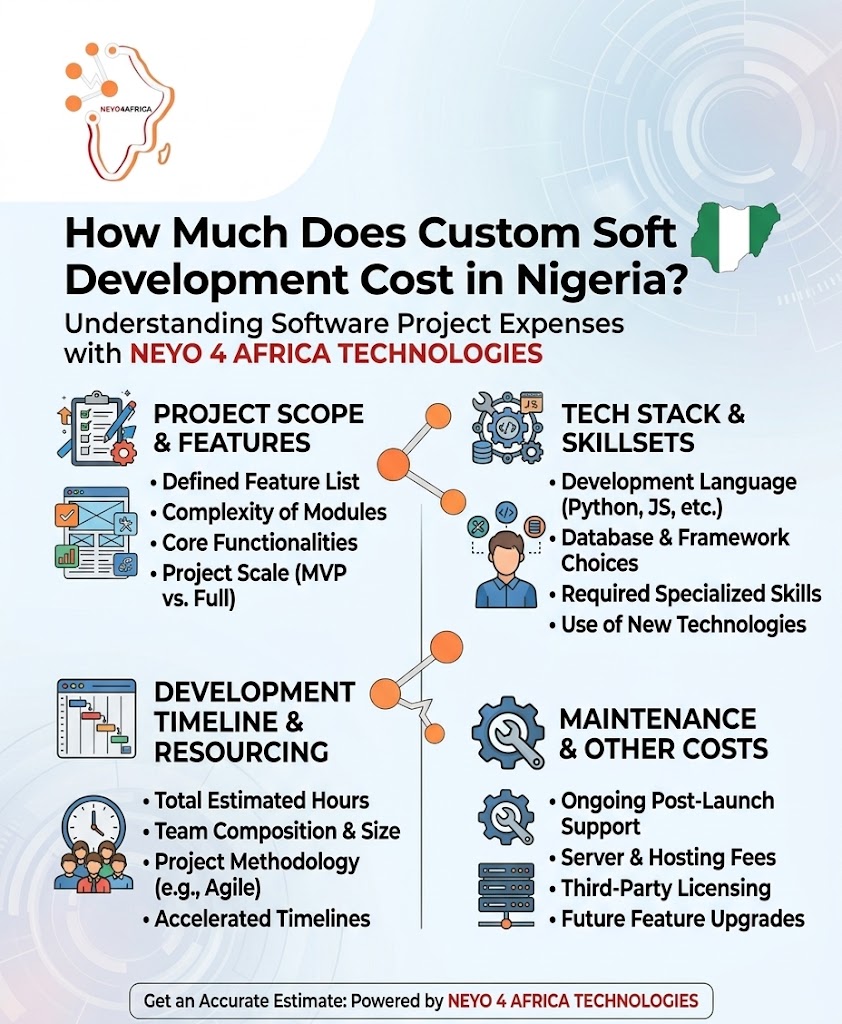
The cost depends on the complexity of the system, the number of users, the features required, integrations, hosting, support and the way the software is licensed.
Custom software costs may include:
- Requirements analysis and planning.
- User interface and experience design.
- Development and testing.
- Database design and data migration.
- Third-party integrations.
- Hosting and deployment.
- Staff training, maintenance and support.
Off-the-shelf software costs may include:
- Initial purchase or subscription fees.
- Charges based on users, usage or selected features.
- Setup and configuration.
- Integration with existing systems.
- Data migration and training.
- Premium support or additional storage.
- Vendor price increases or plan changes.
For a fair comparison, estimate the total cost of ownership over a period such as three years. Include the initial investment and the expected recurring expenses.
A low initial price does not always mean a lower long-term cost, and a higher custom-development cost does not automatically guarantee a better return.
Which Option Is Better for Small Businesses in Nigeria?
For many small businesses, off-the-shelf software is a practical starting point when existing products already handle the required tasks.
A small retailer may need only a suitable point-of-sale and inventory system. A consultant may need an existing invoicing and project management tool. A startup may be able to validate its business idea using ready-made software before investing in a more specialised platform.
Custom software becomes more attractive when existing tools cannot support essential processes, require too many workarounds or fail to integrate the systems the business needs.
Before investing in a custom application, identify the problem, estimate the value of solving it and determine whether a suitable existing product can meet the requirements.
The decision should be based on operational needs and financial sustainability rather than the assumption that custom software is always more advanced.
When Should a Business Consider Custom Software?
Consider custom development when one or more of these situations apply:
- Your business has specialised workflows that existing products cannot adequately support.
- Employees repeatedly transfer data between disconnected systems.
- Current software lacks essential reports or approval processes.
- Integration limitations create operational problems.
- Your business needs a distinctive customer-facing platform.
- Existing software imposes restrictions that interfere with planned growth.
- The long-term cost of workarounds and multiple subscriptions is becoming difficult to justify.
These are signals to investigate custom software, not automatic reasons to commission a project. A suitable existing product or integration may still solve the problem more economically.
How to Choose the Right Software for Your Business
Follow these steps before making a decision.
Step 1: Identify the problem. List the tasks that are slow, expensive, repetitive or difficult to manage with your current tools.
Step 2: Define your requirements. Separate essential features from optional improvements. Consider users, reports, permissions, integrations and security needs.
Step 3: Evaluate existing products. Compare suitable software based on features, reliability, support, licensing and total cost.
Step 4: Identify the gaps. Determine whether missing features can be addressed through configuration, integrations or reasonable changes to your workflow.
Step 5: Calculate the long-term cost. Include subscriptions, implementation, development, hosting, training, maintenance and possible migration costs.
Step 6: Consider data security and ownership. Review access controls, backup arrangements, data export options, licence terms and responsibilities for protecting business information.
Step 7: Plan for growth. Choose a solution that can support your realistic future needs without requiring unnecessary expenditure today.
If custom software appears appropriate, request a written proposal explaining the project scope, deliverables, timeline, testing process, payment milestones, source-code ownership, maintenance and support arrangements.
Can a Business Combine Both Options?
Yes. Businesses do not always have to choose between using only custom software and using only ready-made products.
A hybrid approach may combine existing applications with tailored integrations or a custom module for a specific operational need.
For example, a company could continue using an established accounting application while developing a custom order management platform that connects its sales, inventory and customer service workflows.
This approach can preserve the benefits of existing products while addressing specific gaps.
However, the business should check that the systems can integrate securely and reliably, and establish who will maintain the connections if one of the products changes.
How Neyo4Africa Can Help
Neyo4Africa provides software development services for businesses that need applications designed around their operational requirements. Its software-development offering includes examples such as e-learning applications, appointment booking systems, travel booking platforms, menu ordering systems and management applications.
If your organisation is considering a custom solution, start by identifying the challenges you want the software to solve, the people who will use it and the results you expect.
Explore the Neyo4Africa Software Development service to learn more about its custom application development offering.
Conclusion
Custom software and off-the-shelf software serve different purposes.
Ready-made products can provide a faster and more affordable way to handle common business tasks. Custom software can offer greater flexibility when an organisation has specific workflows, integration requirements or business needs that existing products cannot adequately address.
For Nigerian businesses, the right decision begins with understanding the problem, comparing realistic alternatives and considering the total cost of ownership.
Rather than choosing software because it is popular or highly customised, choose the option that meets your requirements, protects your data and supports your business goals.
Which would you choose for your business: ready-made software that is quicker to deploy, or custom software built around your specific needs? Share your thoughts in the comments.
















No comments yet
Be the first to share your thoughts on this article.