
Technology | Software Development | Nigeria
If you are planning to build custom software for your business in Nigeria, one of the first questions you will probably ask is:
“How much will it cost?”
The answer is not as simple as giving one fixed price.
A small internal business application may cost hundreds of thousands or a few million naira, while a large enterprise platform with multiple users, integrations, dashboards, payment systems, mobile applications and advanced security can cost tens of millions of naira.
This is because custom software is built according to the specific requirements of a business.
In this guide, we explain the factors that determine the cost of custom software development in Nigeria, common software project price ranges, examples of systems businesses build, hidden costs to consider and how to prepare a realistic software development budget.
How Much Does Custom Software Development Cost in Nigeria?
As a general planning guide, custom software projects in Nigeria may fall into these broad ranges:
Type of SoftwareIndicative Cost RangeSimple Internal Business Tool | ₦1.5M – ₦6M
Small Custom Web Application | ₦3M – ₦10M
Medium Business Management System | ₦6M – ₦20M
Multi-Module Business Platform | ₦20M – ₦60M+
Enterprise Software Platform | ₦60M+
These figures are indicative planning ranges, not fixed market prices.
The actual quotation can be significantly different depending on the software requirements, number of users, design, integrations, security, hosting, development team, technology stack and maintenance requirements.
What Is Custom Software Development?
Custom software development is the process of designing and building software specifically for the needs of an individual business, organization or project.
Instead of changing your business processes to fit an existing software package, custom software allows the technology to be designed around your processes.
For example, a company may need software for:
- Customer management
- Inventory management
- Accounting
- Payroll
- Staff management
- School administration
- Hospital management
- Sales management
- Logistics
- Booking
- E-commerce
- Project management
- Reporting
- Business automation
The system can then be designed around the company's actual workflow.
Why Does Custom Software Cost More Than a Simple Website?
A normal business website may primarily provide information.
Custom software is different.
It may have:
- User registration
- Login and authentication
- Different user roles
- Admin dashboards
- Databases
- Reports
- Notifications
- Payment processing
- APIs
- File uploads
- Search
- Business automation
- Audit logs
- Security controls
- Third-party integrations
Every additional function introduces design, development, testing and maintenance requirements.
That is why comparing the price of a five-page website with a custom business management system does not make sense.
They solve completely different problems.
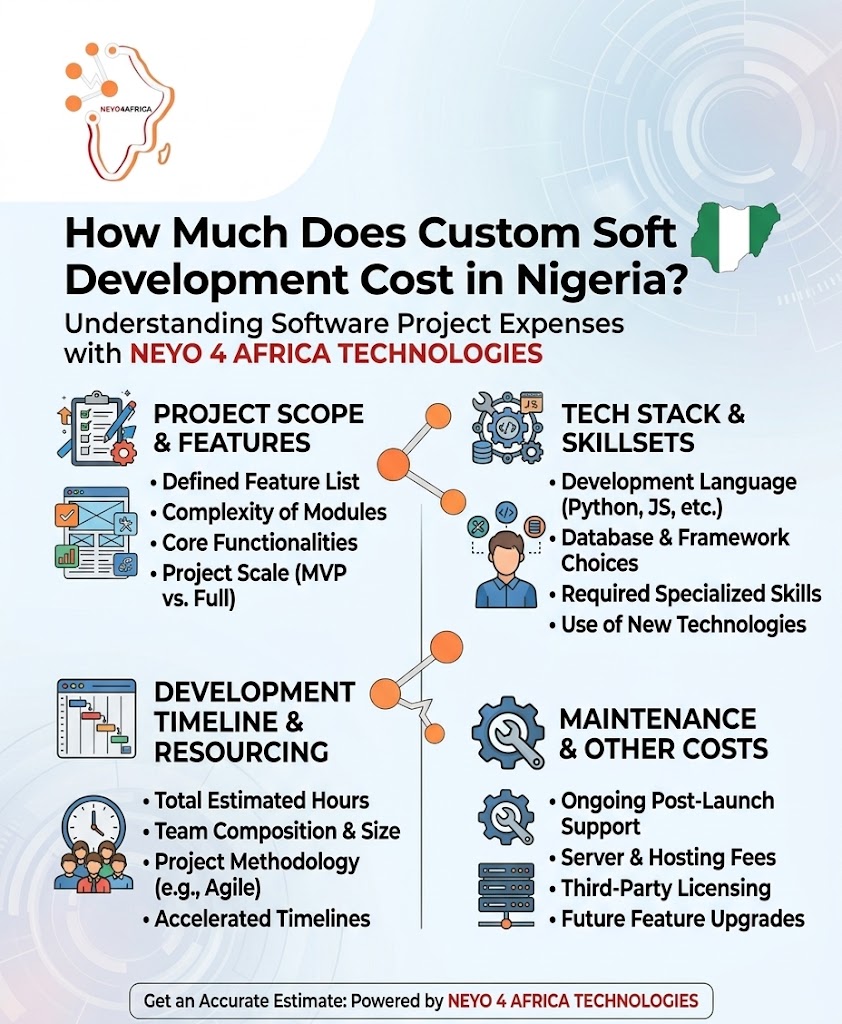
What Determines the Cost of Custom Software in Nigeria?
1. Software Requirements
The first and most important factor is what the software needs to do.
A system with ten simple functions will normally require less development work than one containing dozens of interconnected modules.
Before asking for a quotation, document the functions you need.
2. Number of Users
A system designed for five employees is different from a platform expected to serve thousands of customers.
User volume can affect:
- Infrastructure
- Database design
- Performance
- Security
- Authentication
- Hosting
- Testing
- Scalability
3. User Roles and Permissions
A professional business application may have several types of users.
For example:
Administrator
Can manage everything.
Manager
Can view reports and approve certain activities.
Staff
Can perform assigned tasks.
Customer
Can access only their own information.
This permission structure adds development complexity.
4. Admin Dashboard
Most serious business applications require an administrative interface.
The admin panel allows authorized staff to manage the system without directly interacting with the database.
Depending on the project, the dashboard may include:
- Users
- Customers
- Products
- Orders
- Payments
- Reports
- Settings
- Notifications
- Content
- System activity
For Laravel applications, tools such as Filament can provide structured admin interfaces with tables, forms, actions, dashboards and CRUD functionality.
This can make administration significantly easier for the business.
5. Database Requirements
Custom software normally stores business information in a database.
Examples include:
- Customer records
- Staff information
- Products
- Orders
- Transactions
- Appointments
- Documents
- Reports
The complexity of the relationships between these records can significantly affect development.
6. Payment Integration
If the software needs to process online payments, additional development work may be required.
Examples include:
- Payment gateway integration
- Transaction verification
- Payment status
- Refund handling
- Receipts
- Transaction records
- Notifications
Payment systems also require careful security and testing.
7. Third-Party Integrations
Some businesses need their software to communicate with external services.
Examples include:
- Payment gateways
- SMS providers
- Email services
- Accounting systems
- Google services
- Maps
- CRM platforms
- Government platforms
- Other business APIs
Each integration can introduce additional development and testing requirements.
8. Mobile Application
If customers or employees need to use the system from smartphones, the project may also require a mobile application.
That can significantly increase the project scope.
A software project could therefore consist of:
Web application + Admin panel + Mobile application + API + Database
This is considerably more complex than a simple website.
9. UI/UX Design
Users need to understand how to use the software.
A professional interface should make it easy to:
- Navigate
- Find information
- Complete tasks
- Submit forms
- View reports
- Understand notifications
Poor user experience can make otherwise powerful software difficult to use.
10. Security
Business software may contain sensitive information.
Security requirements can include:
- Secure authentication
- Password protection
- Role-based permissions
- Data validation
- Encryption
- Secure file handling
- Activity logging
- Backups
- Access controls
The more sensitive the information, the more seriously security should be treated.
CUSTOM SOFTWARE DEVELOPMENT PRICE EXAMPLES
Small Business Management System
A small business may need:
- Customer management
- Staff management
- Products
- Sales
- Basic reports
- Admin dashboard
Possible planning range: ₦3M – ₦8M
School Management System
A school may require:
- Student registration
- Teachers
- Classes
- Attendance
- Fees
- Results
- Parent accounts
- Reports
- Admin dashboard
Possible planning range: ₦5M – ₦15M+
E-commerce Platform
An e-commerce platform may require:
- Product catalogue
- Customer accounts
- Shopping cart
- Checkout
- Payment gateway
- Order management
- Inventory
- Delivery management
- Admin dashboard
Possible planning range: ₦5M – ₦20M+
Enterprise Business Platform
A larger organization may require:
- Multiple departments
- Multiple user roles
- Financial modules
- Inventory
- CRM
- Reporting
- APIs
- Mobile applications
- Advanced security
- Multiple locations
Possible planning range: ₦20M – ₦60M+
Large enterprise systems can cost considerably more.
WHY TWO DEVELOPERS CAN GIVE VERY DIFFERENT QUOTES
Imagine you ask three developers to build a business management system.
Developer A says:
₦2 million
Developer B says:
₦8 million
Developer C says:
₦20 million
That does not automatically mean one developer is dishonest.
They may be describing three different scopes.
Developer A may be proposing a basic system.
Developer B may include a custom interface, reporting and integrations.
Developer C may include enterprise architecture, advanced security, testing, documentation, deployment and long-term support.
The important thing is to compare scope, not just price.
WHAT SHOULD A SOFTWARE DEVELOPMENT QUOTATION INCLUDE?
Before approving a project, ask for a clear breakdown.
A professional quotation should ideally explain:
Project scope
What exactly will be developed?
Features
What functions are included?
Technology
What technologies will be used?
Design
Is UI/UX design included?
Database
What database architecture will be used?
Admin panel
Is an administrative dashboard included?
Testing
How will the software be tested?
Deployment
Who will deploy the software?
Hosting
Is hosting included?
Security
What security measures are included?
Maintenance
What happens after launch?
Support
How long will technical support last?
SHOULD YOU BUILD EVERYTHING AT ONCE?
Not always.
One of the smartest approaches for a business with a limited budget is to start with an MVP — Minimum Viable Product.
Instead of spending heavily on every possible feature, identify the functions that are essential to launch.
For example:
Phase 1
- User registration
- Login
- Core business functions
- Admin dashboard
- Database
- Basic reporting
Phase 2
- Payment integration
- Notifications
- Advanced reports
- Mobile application
Phase 3
- Automation
- Advanced analytics
- External integrations
- AI features
- Scaling improvements
This allows the business to launch earlier and invest more as the product proves its value.
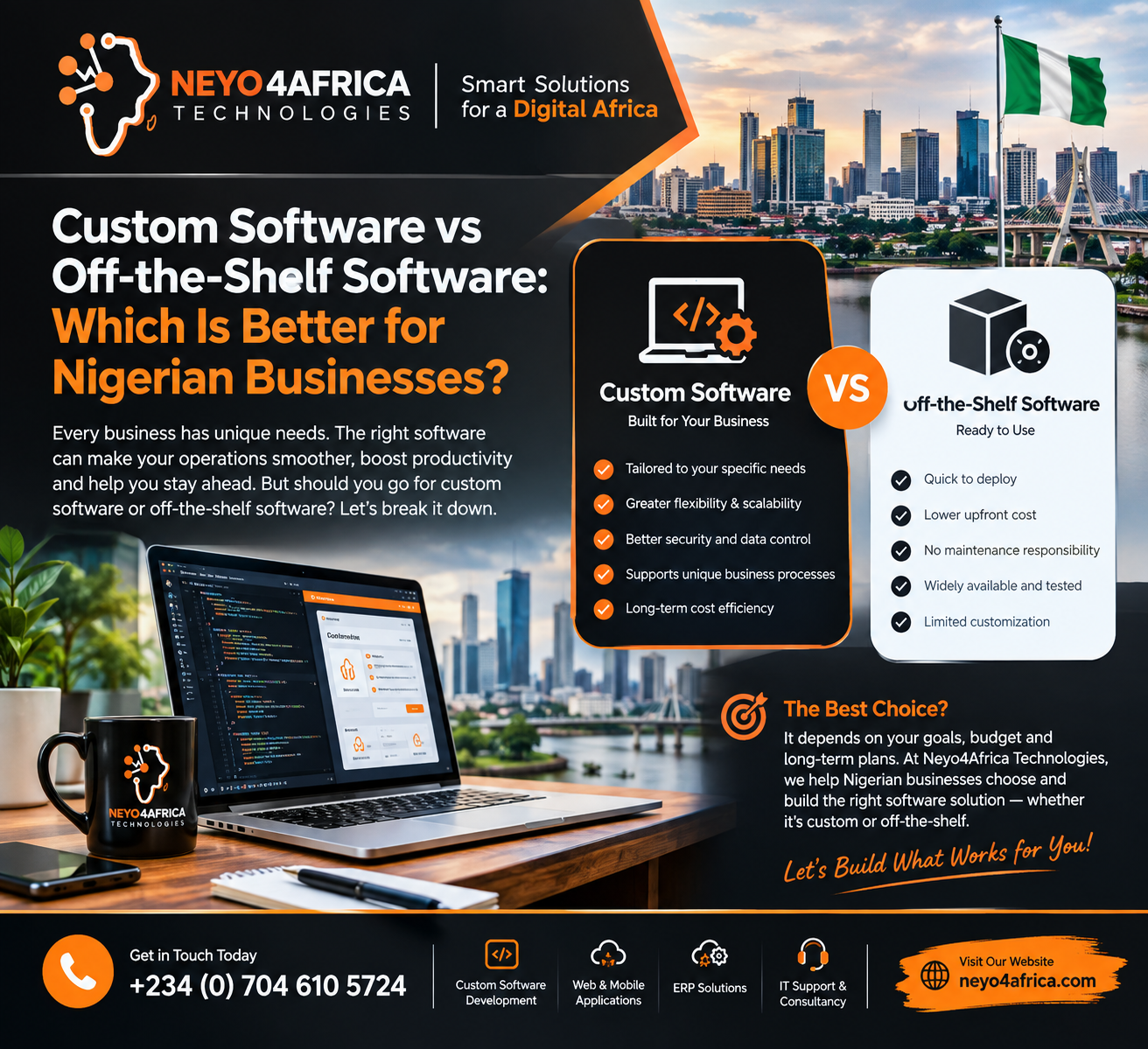
CUSTOM SOFTWARE VS OFF-THE-SHELF SOFTWARE
There are situations where buying existing software makes more sense.
Off-the-shelf software may be appropriate when:
- Your requirements are standard
- You want to launch quickly
- You do not need extensive customization
- Your budget is limited
Custom software becomes more attractive when:
- Your business has unique processes
- Existing software does not meet your requirements
- You need complete control
- You require specialized integrations
- You need a system that can evolve with your business
The right choice depends on the organization.
HOW LONG DOES CUSTOM SOFTWARE DEVELOPMENT TAKE?
Development time depends heavily on scope.
A small application may take a few weeks to several months.
A medium business platform may require several months.
A large enterprise platform can take many months or longer.
The process normally includes:
Planning → Analysis → Design → Development → Testing → Deployment → Maintenance
Laravel itself describes software development around structured application capabilities such as routing, validation, database access, queues, testing and more, while its current documentation also positions it for scalable web applications and API backends.
WHY LARAVEL IS A POPULAR CHOICE FOR BUSINESS APPLICATIONS
Laravel is a PHP web application framework designed for modern application development.
It provides developers with a structured foundation for building web applications and includes capabilities around routing, databases, validation, queues, testing and other application concerns.
For a Nigerian business that needs a custom web application, Laravel can be used as the foundation for systems such as:
- Business management software
- E-commerce platforms
- Customer portals
- Learning systems
- Booking platforms
- Enterprise applications
- APIs
For projects requiring an administrative interface, Filament can be used with Laravel to create admin panels, tables, forms, dashboards and other management interfaces.
WHAT ABOUT FILAMENT ADMIN?
An important part of modern business software is the admin panel.
The admin panel is where authorized staff manage the application.
For example, an e-commerce administrator may use it to:
- Add products
- Edit products
- Manage orders
- View customers
- Check payments
- Manage categories
- View reports
A school administrator could use it to:
- Register students
- Manage teachers
- Create classes
- Record results
- Manage fees
- Generate reports
Filament's Laravel panel builder is specifically designed around resources, forms, tables, actions, dashboards and related management interfaces.
This is one reason a Laravel + Filament architecture can be attractive for certain business applications.
HIDDEN COSTS OF CUSTOM SOFTWARE DEVELOPMENT
The initial development quotation is not necessarily the total lifetime cost.
Businesses should also consider:
- Domain
- Hosting
- Cloud infrastructure
- SSL/security
- Email services
- SMS services
- Payment gateway charges
- Backups
- Maintenance
- Technical support
- Future development
- Third-party API costs
A realistic software budget should consider both development cost and operating cost.
HOW TO REDUCE SOFTWARE DEVELOPMENT COST
You can reduce unnecessary costs without sacrificing the quality of the project.
Start with clear requirements
Poorly defined requirements often result in changes during development.
Prioritize features
Build the essential functions first.
Use an appropriate technology stack
Do not select technology simply because it is popular.
Build in phases
Separate essential features from future improvements.
Reuse proven components
Experienced developers can use reliable frameworks and packages instead of rebuilding everything from zero.
Plan for scalability
Avoid overengineering a small project, but do not build a system that cannot grow.
HOW TO CHOOSE A SOFTWARE DEVELOPMENT COMPANY IN NIGERIA
Do not choose a developer based only on the lowest quotation.
Look at:
Previous projects
Ask to see relevant work.
Technical capability
Does the team understand your type of software?
Communication
Can they explain technical concepts clearly?
Project methodology
How will the project be planned and delivered?
Documentation
Will you receive documentation and system access?
Ownership
Who owns the source code and intellectual property?
Maintenance
Who will maintain the system after launch?
Security
How will your business data be protected?
QUESTIONS TO ASK BEFORE STARTING
Before signing a software development contract, ask:
- What exactly am I paying for?
- What features are included?
- What features are excluded?
- What technology will be used?
- Will I own the source code?
- Who owns the database?
- Will I have access to the hosting account?
- Is an admin dashboard included?
- Is mobile responsiveness included?
- Are APIs included?
- Is testing included?
- Is deployment included?
- How long will development take?
- What happens when additional features are requested?
- What support is provided after launch?
FINAL THOUGHTS
So, how much does custom software development cost in Nigeria?
There is no single answer.
A simple custom application may start around ₦1.5 million, while a medium-sized business system can move into the ₦6 million–₦20 million range. More complex platforms can reach ₦20 million–₦60 million or more, while enterprise systems can require significantly larger budgets.
The most important lesson is this:
Do not choose custom software based on price alone. Choose it based on the business problem it solves, the quality of the development, the scalability of the system and the long-term value it can create.
A well-planned software system can help a business reduce manual work, improve data management, automate processes, improve customer experience and make better decisions.
The right question is therefore not simply:
“How cheap can I build this software?”
It is:
“What will this software help my business achieve?”
Need Custom Software for Your Business?
Neyo4Africa Technologies provides software development and digital technology solutions designed around business requirements.
If your organization has an idea for a business application, management system, customer portal, e-commerce platform or other digital solution, the first step is to clearly define the problem, users, features and expected outcome.
Have a software project in mind?
Share your requirements with Neyo4Africa and start with a proper assessment of the project scope and technology needs.
What Do You Think?
If you had a budget of ₦10 million to develop custom software for your business, what would you build first?
Would you choose:
A business management system, e-commerce platform, school management system, CRM, booking platform or something completely different?
Share your answer in the comments.
















No comments yet
Be the first to share your thoughts on this article.